
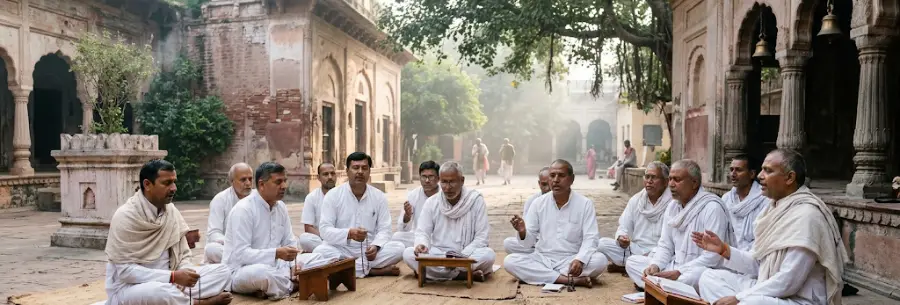
Walk past a Vedic school in India, and you may hear a group of students chanting in a steady, flowing rhythm that has been passed down by ear for many centuries. Today, many people in the UK, the US and Europe are interested in Vedic chanting and stress: can this ancient art of sound help a busy modern mind feel calmer?
In this guide, we explain what Vedic chanting is, how it is preserved, what UNESCO says about it, and what health agencies say about relaxation. We are careful to separate tradition from medical claims.
The short version: Vedic chanting is the traditional recitation of the Vedas with exact pitch, rhythm and pronunciation. UNESCO recognised it in 2008 as an Intangible Cultural Heritage of Humanity. Chanting involves slow breathing and focus, which are features of relaxation practices that health agencies say can help with stress. It is not a medical treatment, and claims of cures are not supported.
▶ Watch the Web Story: Vedic Chanting and Stress
Table of Contents
What Is Vedic Chanting?
The four Vedas, the oldest texts of the Hindu tradition, were composed and passed on in spoken form. For centuries, they were learned by listening and repeating, not by reading. The chanting that preserves them is called Vedic chanting or Vedic recitation.
The chants follow strict rules of sound, including pitch accents, length of syllables and rhythm. The aim is to keep every verse exactly as it was received. If you want the background of the four collections, read our guide to the four Vedas.
Why sound matters in the Vedas
In the Vedic view, sound is not only a carrier of meaning. The sound itself is treated with deep respect, and correct pronunciation is considered an important part of the practice. This is why teachers insist on learning by ear from a skilled guide.
A famous Rigveda verse, from the very first hymn, shows how central the spoken word was:
अग्निमीळे पुरोहितं यज्ञस्य देवमृत्विजम् । होतारं रत्नधातमम् ॥
agnim īḷe purohitaṃ yajñasya devam ṛtvijam | hotāraṃ ratnadhātamam ||
Rigveda 1.1.1
Meaning: I praise Agni, the household priest, the divine minister of the sacrifice, the one who calls the gods and bestows treasures.
The verse begins with the words “I praise”. The Vedic hymns were meant to be sung or spoken aloud, and the sound was part of the offering.
UNESCO and Vedic chanting
In 2008, UNESCO inscribed the tradition of Vedic chanting on its Representative List of the Intangible Cultural Heritage of Humanity. You can read the official entry on the UNESCO website.
UNESCO describes it as one of the oldest living oral traditions, and highlights the careful methods by which it has been preserved. This recognition is about cultural heritage. It is not a health claim, and it does not say that chanting treats any condition.
The Samaveda: the Veda of melodies
Among the four Vedas, the Samaveda is most closely tied to music. Many of its verses are drawn from the Rigveda and set to melodies for singing. The very first verse of the Samaveda is a call to Agni:
अग्न आ याहि वीतये गृणानो हव्यदातये । नि होता सत्सि बर्हिषि ॥
agna ā yāhi vītaye gṛṇāno havyadātaye | ni hotā satsi barhiṣi ||
Samaveda 1.1 (also Rigveda 6.16.10)
Meaning: O Agni, come, being praised, to receive the offerings; sit down as the priest on the sacred grass.
Scholars note that the singing traditions of the Samaveda are a root of Indian musical thought. You do not need to be a musician to enjoy the idea: simple, repeated, rhythmic sound is a human habit found in many cultures.
How Vedic chanting is learned
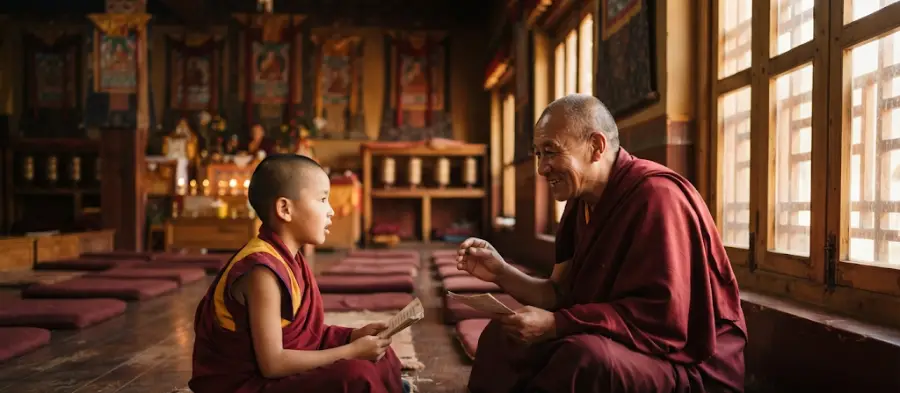
In the traditional way, a student sits with a teacher and repeats each phrase after hearing it. Learning is slow and patient, and may take years. Several methods of recitation exist, which help to keep the text exact.
For a beginner at home, a gentler approach is fine:
- Listen to a recording by a respected teacher.
- Repeat one line at a time, slowly.
- Learn the meaning, so the words are not only sound.
- Practise a few minutes every day.
- If you can, find a local teacher or a trusted online class.
Chanting and the Breath
Chanting naturally slows the breath. You breathe in, and then you let the sound carry out the breath slowly. This longer outbreath is a feature of many relaxation techniques.
You can try a simple experiment. Take a normal breath, and then hum or say “aaa” or “ooo” on the outbreath for as long as feels comfortable. Notice how the body feels afterwards. Many people feel a little calmer. This simple sound practice is a gentle starting point, and you can read about the syllable Om in our Om chanting guide.
Vedic Chanting and Stress: What Research Says
The NCCIH, a US government health agency, explains in its relaxation techniques overview that practices such as meditation, deep breathing and guided imagery can help people manage stress and may help with some conditions, and that they are generally safe for healthy people.
Chanting shares some features with these practices: slow breathing, steady focus and a quiet setting. So it is reasonable to expect that it may help some people relax. However, the research specific to Vedic chanting is limited, and we should not claim more than we know.
Vedic Chanting Benefits for Stress
- Slower breathing. The long outbreath of chanting can calm the body.
- A single focus. The mind rests on one rhythm instead of many worries.
- A break from screens. A few minutes of sound and silence are a real pause.
- Routine. A daily practice gives structure.
- Belonging. Chanting with others can lift the mood.
These are gentle effects. If stress is severe or long-lasting, please talk to a doctor or counsellor.
Chanting for Stress Relief: A 10-Minute Routine
- Minute 1: sit comfortably, close your eyes and take three slow breaths.
- Minutes 2 to 3: hum quietly on the outbreath, five times.
- Minutes 4 to 8: chant a short verse or mantra you know, slowly and softly.
- Minutes 9 to 10: sit in silence. Notice your breath and the feeling in your chest and shoulders.
Do this once or twice a day for a week, and then see how you feel. If you like a body-based practice, you could follow it with a short rest, as in our yoga nidra guide.
Vedic Chanting for Beginners: Simple Sounds
- Om: three slow repetitions, with a long hum at the end.
- Shanti: a calm repetition of the word for peace.
- A short mantra: such as the Gayatri mantra, learned from a teacher or recording.
- Soft humming: if you prefer no words at all.
Chanting with others
Many people find group chanting especially uplifting. Shared sound brings a sense of belonging and shared purpose. You might join a local temple, a cultural centre or a yoga class that offers chanting, or you can chant with family at home.
If you join a group, go at your own pace, respect the customs of the place, and feel free to simply listen at first.
What chanting cannot do
- It cannot cure disease.
- It cannot replace therapy, medicine or medical advice.
- It cannot guarantee results, such as better exam marks or wealth.
- It cannot make problems vanish. It can only help you meet them with more calm.
Who should be careful
- If you feel dizzy while chanting, stop and breathe normally.
- If you have a lung condition, do not strain your breath.
- If you are going through a mental health crisis, seek professional help rather than relying on chanting alone.
- If you have a throat problem, keep the volume low.
Common myths
- Myth: chanting cures stress disorders. It may help you relax, but it is not a treatment.
- Myth: you must understand Sanskrit perfectly. You can start with a few lines and the meaning.
- Myth: only men may chant the Vedas. Many modern teachers welcome women and people of all backgrounds, though some traditional schools have their own customs.
- Myth: loud chanting is better. A soft, steady voice is fine.
Why people connect Vedic chanting and stress relief
The link between Vedic chanting and stress relief is easy to understand when you look at what happens during chanting. The breath slows. The shoulders drop. The mind follows a steady rhythm instead of racing from worry to worry. Many people also feel that the shared nature of chanting reduces loneliness.
These effects are similar to what the NCCIH describes for other relaxation practices. At the same time, honest writers should say that scientific studies on Vedic chanting itself are still few and small. So the most accurate statement is that Vedic chanting and stress relief seem to go together for many people, and that more research would help to confirm it.
The role of rhythm and repetition
Repetition is used in many cultures to calm and focus the mind: lullabies, prayers, work songs and counting breaths. In Vedic chanting, repeated patterns of sound give the mind a pleasant, predictable path to follow.
When we are stressed, our thoughts often jump from one worry to another. A steady rhythm gives the attention a place to rest. You can use the same idea in daily life, for example by repeating a calm word as you walk, or by counting four slow breaths before a meeting.
This is not magic. It is a simple, human way of settling the mind, and it can be done by anyone, in any tradition.
Stress in daily life: where chanting fits
Stress has many causes, such as work, money, family and health. Chanting does not remove these causes, but it can help you respond with more steadiness. It is best seen as one tool among several.
- Sleep: aim for a regular bedtime. See our Ayurvedic bedtime routine.
- Food: eat regular, balanced meals.
- Movement: walk or stretch daily, for example with Surya Namaskar.
- Connection: talk with friends and family.
- Quiet time: a short chant, breathing practice or rest.
If you want more ideas, see our guide to natural stress relief techniques.
How to choose what to chant
You do not have to chant a Vedic verse to enjoy the benefits of calm sound. You can choose what suits you.
- A Vedic verse or mantra, if it is part of your tradition.
- A single sound, such as Om or a soft hum.
- A word of peace in a language you speak.
- A short phrase of your own, such as “I am calm”.
The best choice is the one you can repeat comfortably and sincerely. Many people prefer to start with a very short sound, and move to longer verses once they feel at ease.
Preserving the tradition respectfully
When we learn from a living tradition, it is good to do it with respect. A few suggestions:
- Learn from teachers or recordings that give proper credit.
- Do not treat sacred verses as background music in shops or on party playlists.
- Do not make exaggerated health claims about chanting.
- Support the people and schools who keep the tradition alive, if you can.
Respect is not only polite. It also keeps the practice honest, which is what helps people trust it.
A weekly plan to build your practice
If you want to try chanting in a steady way, this simple plan may help.
- Days 1 to 2: hum quietly on the outbreath for two minutes each morning.
- Days 3 to 4: add three slow repetitions of Om.
- Days 5 to 6: add one short verse, learned from a recording.
- Day 7: chant for ten minutes, and write down how you feel.
After a week, decide what you want to keep. Even two minutes a day is a good habit. The goal is not to chant more, but to find a gentle rhythm of sound and silence that helps you through your week.
Common questions from first-time chanters
Many beginners worry about doing it wrong. Here are honest, simple answers. You do not need to sit in a special posture; a chair is fine. You do not need a perfect voice; a quiet, steady one is enough. You do not need to chant for a long time; five minutes counts.
If your mind wanders, that is normal. Gently come back to the sound, just as you would bring your attention back to your breath. If you feel self-conscious, practise alone at first, or with headphones. Over time, the practice usually feels more natural.
Finally, remember that the point is not to perform, but to rest. A calm, kind attitude toward yourself is the best part of any practice, and a good habit for a stressful week.
Bringing Vedic chanting and stress care together
In summary, Vedic chanting and stress care meet in simple places: the slow breath, the steady rhythm, the quiet pause and the feeling of connection. These are old human tools, and modern health agencies recognise similar tools as helpful for relaxation.
Keep your approach balanced. Enjoy the beauty and the heritage of the chants. Use them as one part of a healthy life that also includes sleep, food, movement and support from other people. And if stress becomes heavy, reach out to a doctor or counsellor, as there is real help available.
Vedic Chanting and Stress FAQs
Is Vedic chanting good for stress?
It may help many people relax, because it involves slow breathing and focus, but research on chanting alone is limited.
What did UNESCO say about Vedic chanting?
In 2008, UNESCO recognised Vedic chanting as part of the Intangible Cultural Heritage of Humanity.
Which Veda is for singing?
The Samaveda, which sets verses to melodies.
How long should I chant each day?
Even 5 to 10 minutes is enough to start.
Do I need a teacher?
A teacher is best for correct sounds, but beginners can start with a good recording.
Further reading
This article is for general education and cultural information, not medical advice. If symptoms persist or worry you, please speak with a qualified healthcare professional. Images on this page were created with AI.