
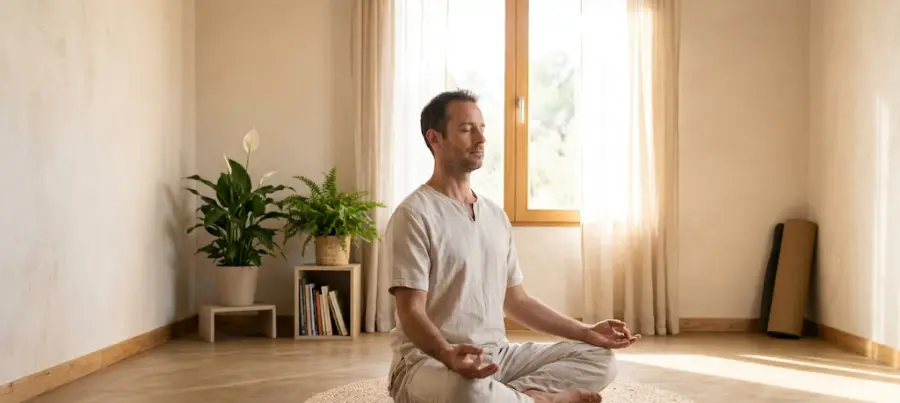
You have probably heard it at the start of a yoga class, in a temple, or at the end of a calm meditation. Om (also written Aum) is the most recognised sound in the Sanatan tradition. But what does it really mean, and what are the real Om chanting benefits, apart from internet claims?
This guide answers both questions in plain words. You will learn what Om means in the Vedic tradition, how to chant it comfortably, what research on meditation and focused attention says, and who should take extra care. Each section is short and easy to read.
The short version: Om is a sacred syllable in the Vedic and Upanishadic tradition, said to stand for the whole of existence. Chanting it is a form of focused meditation. Research on meditation shows modest benefits for stress, anxiety and sleep, but no study proves that Om cures illness. Chant softly for 3 to 5 minutes, and stop if you feel dizzy or uneasy.
▶ Watch the Web Story: Om Chanting Benefits
Table of Contents
What Does Om Mean? The Sacred Syllable Explained
Om is a single syllable with a long history. In Sanskrit it is also called pranava, which means “that which is hummed or resounded”. Hindus, and also Buddhists and Jains in their own ways, use it in prayer and meditation.
Practically, Om is a long, steady sound. You breathe in, then chant “A-U-M” as you breathe out slowly, ending in a soft hum. The sound vibrates gently in the chest, throat and head, which many people find soothing.
In the Vedic tradition, Om is placed at the beginning and end of many mantras. For example, the Gayatri Mantra begins with it (read the Gayatri Mantra meaning to see how).
Om in the Vedas and Upanishads
The syllable Om is woven through Vedic literature. It appears in the ritual texts and is explained at length in the Upanishads, which form the last layer of each Veda. If you want to see how the layers fit together, our guide to the four Vedas makes it easy.
The Mandukya Upanishad is a short text devoted almost entirely to Om. It begins with a famous line:
ओमित्येतदक्षरमिदं सर्वम्
om ity etad akṣaram idaṃ sarvam
Mandukya Upanishad 1
Meaning: Om: this syllable is all of this.
In plain language, the sage is saying that Om stands for everything: past, present and future, and also what lies beyond time. This is a spiritual statement, not a scientific one, and it is best understood as an invitation to contemplate the whole of reality in a single sound.
The Katha Upanishad also praises Om as the goal of all the Vedas. Different texts describe it in different ways, which is part of why it is so rich.
The three sounds and the silence
The Mandukya Upanishad explains Om as having four parts. Three are sounds, and the fourth is the silence after the sound:
- A is linked in tradition with the waking state.
- U is linked with the dream state.
- M is linked with deep sleep.
- The silence that follows is called turiya, the “fourth”, a state of calm awareness beyond the other three.
You do not have to hold any belief to enjoy this practice. You can simply notice that the sound moves from the open mouth (A), to the rounded lips (U), to the closed lips and hum (M), and then rests in quiet. That physical journey of the sound is easy to feel.
Om chanting benefits: what people report
Many people say that chanting Om helps them feel:
- calmer and less rushed
- more focused before study or work
- more grounded after a stressful day
- ready to wind down at night
- connected to something larger than daily worries
These are personal experiences. They matter, and they are a good reason to try the practice. But personal experience is not the same as proof, so let us look at what research can say.
Om chanting benefits: what research suggests
Here is what is known. The US National Center for Complementary and Integrative Health (NCCIH) describes focused meditation as holding attention on a sensation, a sound, an image or a mantra. Chanting Om fits this description.
For meditation as a group of practices, NCCIH reports:
- A 2018 analysis of 142 groups (over 12,000 participants) found mindfulness better than no treatment for anxiety and depression, and about as effective as some established therapies.
- For anxiety disorders, a 2021 analysis found mixed short-term results and few studies beyond two months.
- For sleep, a 2019 analysis of 18 studies found mindfulness improved sleep quality more than education-based treatments, though not more than cognitive behavioural therapy or exercise.
- For blood pressure, the evidence is limited, though a 2020 review found some reduction with structured mindfulness programmes.
What about Om specifically? A number of small studies have looked at chanting and humming. Most are short, small, and not of the highest quality, so it would be wrong to claim proven effects. The honest summary is this: Om chanting is a low-cost, low-risk way to practise focused attention, and meditation as a whole has modest benefits for many people. Treat the Om chanting benefits as likely helpful for relaxation, but not as a treatment for any disease.

How to Chant Om Step by Step
Follow these steps. They take about two minutes to learn:
- Sit comfortably. On a cushion or a chair, spine tall, shoulders soft. Rest your hands on your knees.
- Close your eyes. Or lower your gaze to the floor.
- Breathe in slowly through your nose, filling the belly and then the chest.
- Say “Aaa”. Begin with an open mouth. Let the sound start from the belly.
- Move to “Uuu”. Round your lips gently.
- End with “Mmm”. Close your lips and feel a soft hum in your face and head.
- Rest in silence. Take a breath, and notice the quiet for a few moments.
- Repeat. Do three to nine rounds to start.
Most Om chanting benefits come from a smooth, unforced rhythm. A comfortable pace is about 15 to 20 seconds for each round, with the “Mmm” being the longest part. Do not strain to make it longer.
Om Chanting for Beginners: A 5-Minute Routine
- Minute 1: sit, relax your jaw and take five slow breaths.
- Minutes 2 to 4: chant Om six to nine times, slowly.
- Minute 5: sit in silence, and notice how your body and mind feel.
Try the routine at the same time every day, such as after you wake or before you start work. If you enjoy a morning ritual, you may like our guide to Brahma Muhurta, which is a traditional time for quiet practice.
Om Chanting Tips: Voice, Breath and Posture
- Use a low, soft voice. A natural speaking pitch is perfect. Do not push your voice.
- Breathe through the nose. It slows the breath and warms the air.
- Keep the neck relaxed. Imagine the head floating on the spine.
- Drop the shoulders. Let your hands rest on your knees.
- Let the sound fade naturally. End each round without gasping.
- Try a quiet room first. You will hear your own sound better.
Om Chanting Benefits for Sleep and Stress
Many people like to chant Om in the evening, as a way of ending a busy day. This fits with ordinary sleep advice. The NHS suggests using the hour before bed for calming activities such as reading, meditation, breathing exercises or quiet music, and avoiding screens in that hour. A few rounds of Om fit nicely into a wind-down. You can pair it with the habits in our Yoga Nidra guide or our ayurvedic bedtime routine.
For stress, slow, rhythmic sound is a simple way to calm your breathing. Be realistic though. If you feel overwhelmed or anxious for weeks at a time, talk to a doctor. Chanting can sit beside treatment, but it is not a replacement.
Common mistakes
- Chanting too loudly. It can strain the throat. Soft is better.
- Rushing the hum. The “Mmm” is the heart of the practice, so give it time.
- Holding the breath. Keep the breath smooth.
- Expecting a special experience. The goal is calm attention, not fireworks.
- Practising when unwell. If you have a cold or blocked nose, wait.
- Treating it as a cure. It is a practice, not a medicine.
Who should be careful
Chanting is gentle, but please take care if any of these apply:
- You feel dizzy or light-headed. Stop, breathe normally and rest.
- You have a heart condition, high blood pressure or a lung condition. Keep your breath gentle, and ask your doctor.
- You have a sore throat or voice problem. Chant softly or silently.
- You find silence or inward focus frightening. NCCIH notes that about 8% of participants in a large review of meditation studies reported a negative effect, most commonly anxiety or low mood. If that happens, stop and speak to a health professional.
- You are in the middle of a mental health crisis. Please seek professional support first.
NCCIH also advises that meditation should not be used to replace conventional care or to delay seeing a provider about a medical problem.
How to combine Om with other practices
- With yoga. Chant Om before or after your session. It pairs well with Surya Namaskar.
- With breathing. Follow with two minutes of alternate nostril breathing.
- With a mantra. Begin the Gayatri Mantra with Om.
- With journaling. Chant, then write for five minutes.
- With rest. End the day with Om and a quiet pause.
A week-by-week plan
- Week 1: 3 rounds, once a day.
- Week 2: 6 rounds, once a day.
- Week 3: 9 rounds, and add 2 minutes of silence.
- Week 4: choose the length that suits you, between 5 and 10 minutes.
At the end of the month, notice what has changed. Are you a little calmer? Do you sleep slightly better? If you notice nothing, that is fine too. Different practices suit different people, and the Om chanting benefits are quiet and gradual, not dramatic.
Why a long, soft hum feels calming
A fair question is why chanting Om feels calming at all. Nobody needs a miracle to explain it. A few ordinary reasons are enough, and they are easy to test on yourself.
- Slow breathing. Chanting makes the out-breath long. A longer out-breath usually slows the breathing rate.
- One thing to follow. The sound gives a busy mind a single, simple job. That is the core of focused meditation.
- Gentle vibration. The hum is felt in the lips, face and chest, which keeps attention in the body.
- Pause and routine. A short ritual tells your mind, “now we slow down”.
None of these reasons is magical, and none needs a belief. That is good news, because it means the practice is open to anyone who wants to try it with an open mind.
Om in everyday life: small, realistic ideas
You do not need a temple or a long retreat. Here are realistic moments when a few rounds of Om fit into normal life:
- Before an exam or interview: three slow rounds, then a breath, to settle your nerves.
- After work: two minutes on a chair, to mark the end of the working day.
- On a quiet walk: hum a soft Om in your mind in time with your steps.
- Before a family meal: one round together, if your family enjoys it.
- At bedtime: three rounds, then lights out, with no phone.
The idea is to make Om a small, friendly habit. It should add calm to your day, not another thing on your to-do list.
Respect for the tradition
Om is sacred to millions of people. It is nice to approach it with respect, even if you use it only for relaxation. Learn a little about where it comes from, and avoid using it in jokes or decoration without thought.
If you are curious about the deeper meaning, read the Mandukya Upanishad with a good commentary, or ask a teacher. The Upanishads are the culminating layer of the Vedic texts, and they have inspired thinkers for thousands of years.
It is also fine to say, “I do this simply for calm”. Honest practice, with respect for the source, is a good place to start.
Claims to be careful about
The internet is full of big promises about Om. Here are some you may see, and a calm response to each:
- “Om cures anxiety and depression.” There is no evidence that it cures them. Meditation may help some people, alongside proper care.
- “Om at a special frequency heals the body.” No good evidence supports this. Be wary of such claims.
- “Om boosts immunity.” There is no reliable proof. Sleep, food, vaccination and exercise matter far more.
- “Om works instantly for everyone.” Results vary, and most people notice small, gradual changes.
A good rule: if a claim sounds too big to be true, check it against a trusted health source before you believe it.
Om Chanting FAQs
How many times should I chant Om?
Start with three to nine times. Many traditions use 21 or 108 repetitions, but a smaller number said with full attention is perfectly good.
What is the best time to chant Om?
Early morning and evening are traditional. Choose a time when you can be calm and unhurried.
Can I chant Om silently?
Yes. Silent chanting, where you hear the sound in your mind, is often used in meditation. Start aloud, then try silently.
Are there side effects of chanting Om?
Side effects are rare. Some people feel dizzy if they breathe too forcefully, or uneasy during silence. Stop if you feel unwell.
Is Om only for Hindus?
Om has deep roots in Hindu tradition, and it is also used by Buddhists and Jains. Many people of different backgrounds enjoy it as a calming sound, and it is nice to respect where it comes from.
Do Om chanting benefits include better concentration?
Many people report better focus after a short session, and focused attention is exactly what the practice trains. Research on meditation in general supports modest benefits, but individual results vary.
Can I chant Om at night?
Yes. Many people like it as part of a wind-down. Keep your voice low, and avoid bright screens afterwards.
Should I chant Om before or after yoga?
Either works. Before yoga it can help you focus, and after it can help you settle. Choose what feels right.
Further reading
- NCCIH: Meditation and Mindfulness: What You Need To Know
- NHS Every Mind Matters: How to fall asleep faster and sleep better
This article is for general education and cultural information, not medical advice. If symptoms persist or worry you, please speak with a qualified healthcare professional. Images on this page were created with AI.