

Most of us do not have a sleep problem so much as an evening problem. The day ends, but nothing about the evening tells the body that it has. Dinner is late, the laptop is still open on the sofa, and then we climb into bed and expect to switch off like a lamp.
An ayurvedic bedtime routine goes after exactly that gap. Ayurveda, the traditional system of medicine from India, has long treated the hours before bed as something you prepare for rather than something that simply happens to you. Below we pair that tradition with what current guidance from the NHS and the US National Heart, Lung, and Blood Institute actually says, so you can keep what is practical and leave what is not backed by anything more than habit.
The short version: a workable ayurvedic bedtime routine is about an hour of low light and low effort. Eat dinner earlier and lighter, put the phone away, do something warm (a bath, a foot soak, a cup of tea), take a few slow breaths, write down tomorrow’s list, and do it in the same order every night. It is a habit routine, not a cure for insomnia.
Table of Contents
What Ayurveda says about evenings
In classical Ayurvedic teaching the day moves through phases, and the evening is described as a heavier, slower stretch of time. The advice that follows is simple: eat dinner on the lighter side, let your activity wind down, and be in bed at a regular hour instead of catching a second wind at 11pm. The wider daily rhythm is called dinacharya, and we look at it more closely in our guide to the ancient Ayurvedic daily routine.
It helps to be plain about what this is. It is a tradition of daily habits, not a tested treatment for insomnia. The US National Center for Complementary and Integrative Health notes that there is little scientific evidence for Ayurvedic approaches for most health problems, and it warns that some Ayurvedic products have been found to contain lead, mercury or arsenic at toxic levels (NCCIH: Ayurvedic Medicine In Depth). So we lean on the habits, which cost nothing and carry little risk, and stay careful with anything you swallow or buy.
What sleep research agrees on
The reassuring part is how much the habit side of an ayurvedic bedtime routine overlaps with mainstream sleep advice. The NHS suggests going to bed and getting up at similar times each day, keeping the bedroom quiet, dark and cool, cutting back on caffeine, and trying not to use phones, tablets or computers for an hour before bed. The NHLBI adds that the effects of caffeine can last up to eight hours and that weekend sleep times should stay within about an hour of weeknight times.
Put side by side, the two traditions agree on more than you might expect: regular timing, a calm evening, less stimulation. Where they part ways is mostly in the extras, which we come to further down.
A 60-minute ayurvedic bedtime routine you can actually follow
Your ayurvedic bedtime routine does not need to include everything below, and it certainly does not need to be done perfectly. Pick the steps that suit your home and your evenings, then do them in the same order each night. The repetition is doing a lot of the work.
1. Finish dinner earlier and keep it lighter
Ayurveda’s usual advice is an earlier, lighter evening meal. Sleep services say much the same: Sleepstation suggests finishing big or fatty meals earlier and choosing lighter evening snacks. As a rule of thumb, many people find that leaving a couple of hours between dinner and bed feels comfortable. Treat that as a starting point, not a law.
2. Dim the lights and park the phone
The NHS suggests avoiding screens for an hour before bed. If that sounds impossible, start with thirty minutes. Choose one spot outside the bedroom where the phone sleeps, and plug the charger in there. It also removes the temptation to check one last message at 1am.
3. Take a warm bath or a foot soak
A warm foot wash is a traditional evening habit, and a warm bath or shower is a common wind-down step in modern sleep programmes. Sleepstation notes that part of the benefit is the cooling-down afterwards, which suits the body’s natural drop in temperature at night. Ten to fifteen minutes is plenty. Dry your feet well and pull on socks if they get cold.

4. Slow your breathing for five minutes
Alternate nostril breathing, known as nadi shodhana, is the classic breathing practice in Ayurvedic and yoga traditions. The evidence for any specific breathing pattern is modest, so we will not promise what it does to your brain. What it does give you is something to focus on other than replaying the day. Sit comfortably and breathe in gently for a count of four and out for a count of six. If counting makes you more alert, drop the numbers and simply let each breath out be a little longer than the breath in.
If your mind refuses to settle, our guide to why overthinking never stops covers a few calmer ways to handle it.
5. Write tomorrow’s list
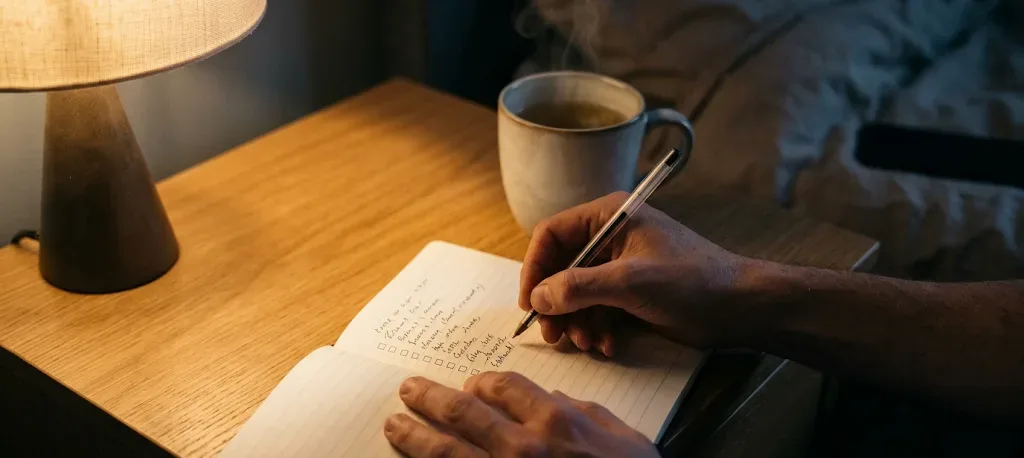
The NHS suggests writing your worries down, or listing what you need to do tomorrow, if you tend to lie awake with them. Three minutes with a plain notebook is enough. The aim is not to solve anything, only to hand the problem to the page so your head can stop carrying it.
6. Choose something warm without caffeine
The NHS suggests a warm milky drink or herbal tea in place of caffeinated drinks. Tradition often adds a pinch of nutmeg or cardamom to warm milk. There is no good evidence that the spice improves sleep, so think of it as flavour and ritual rather than medicine, and keep it to a pinch because nutmeg in large amounts can be harmful. Skip any ingredient you are sensitive or allergic to, and have the drink early enough that you are not up for the toilet at 3am.
Traditional extras worth a careful look
A traditional ayurvedic bedtime routine often includes a few more things, and some people enjoy them. Here is an honest word on each.
- Warm oil massage (abhyanga). Many people find a slow self-massage of the feet or scalp relaxing, and there is little harm in it. Patch-test any new oil on a small area of skin first, and keep oil off your bedding and well away from candles.
- Herbs such as ashwagandha or brahmi. These are popular, and we are not recommending them. Quality and strength vary a lot between products, and the NCCIH warning about contamination applies. If you are pregnant, breastfeeding, taking medication or have a health condition, speak to a doctor or pharmacist first.
- Strict bedtimes. Ayurvedic sources often suggest being in bed by around 10pm. Research puts more weight on keeping a consistent time, within an hour or so across the week, than on a particular clock hour.
A sample evening timeline
Here is one way an ayurvedic bedtime routine could fit together if you aim to be asleep by 11pm. Shift everything earlier or later to match your own day.
| Time | What you do |
|---|---|
| 8:00pm | Finish dinner (lighter, earlier) |
| 9:00pm | Write tomorrow’s list, tidy up, phone to its parking spot |
| 9:30pm | Lights down, warm bath or foot soak |
| 10:15pm | Five minutes of slow breathing, then a warm caffeine-free drink |
| 10:30pm | Read something on paper in dim light |
| 11:00pm | Lights out in a cool, dark, quiet room |
Sleepstation estimates it takes around two months for a new routine to settle into a habit, so give it a few weeks before you judge it. If you miss a night, just pick it up again the next evening.
If you still can’t sleep
It happens to everyone, routine or not. The NHS advice is that if you are still awake after about 20 minutes, get up, do something relaxing somewhere else with the lights low, and go back to bed when you feel sleepy. Try not to watch the clock. Checking the time tends to make the worry louder.
If tiredness is the bigger problem during the day, our piece on why you may feel tired all the time is a good next read, and natural stress relief with Ayurveda covers the stress side.
When to see a doctor
An ayurvedic bedtime routine is a good first step, but it is not the answer to everything. The NHS insomnia page suggests seeing a GP if changing your sleep habits has not helped, if sleep problems have lasted for months, or if poor sleep makes daily life hard to cope with. It describes cognitive behavioural therapy (CBT) for insomnia, delivered face to face or through an online programme, as a way to change the thoughts and habits that keep you awake, and it notes that sleeping tablets are now rarely prescribed because of side effects and dependence. If a partner notices that you stop breathing or gasp in your sleep, mention that to a doctor too.
Questions people ask
How long does an ayurvedic bedtime routine take to work?
Some people feel calmer within a few nights, but habits take time. Sleepstation suggests around two months for a routine to become second nature. Judge it over a few weeks, not a few days.
Does warm milk with nutmeg help you sleep?
There is no good evidence that it does. A warm, caffeine-free drink is a sensible part of a wind-down, and the NHS suggests one, but the nutmeg is tradition rather than proven help. Use only a pinch.
What time should I go to bed according to Ayurveda?
Ayurvedic sources often suggest around 10pm. Sleep research emphasises consistency instead, keeping your bedtime and wake time similar every day, including weekends. Pick a time you can keep.
Is it safe to take Ayurvedic herbs for sleep?
Not automatically. Products vary in quality, and some have been found to contain heavy metals. Check with a doctor or pharmacist before starting any herb, especially if you take medication, are pregnant or breastfeeding, or have a medical condition.
A small place to start tonight
Do not rebuild your whole evening in one go. Choose two steps from this ayurvedic bedtime routine, say phone parked at nine and a warm drink at ten, and keep them for a week. Add a third when the first two feel normal. A routine that you repeat beats an ideal one that you abandon by Thursday.
Further reading
- NHS: How to fall asleep faster and sleep better
- NHS: Insomnia
- NHLBI: Healthy sleep habits
- NCCIH: Ayurvedic Medicine In Depth
- Sleepstation: Wind-down routine
This article is for general education and is not medical advice. If symptoms persist or worry you, please speak with a qualified healthcare professional. Images on this page were created with AI.