
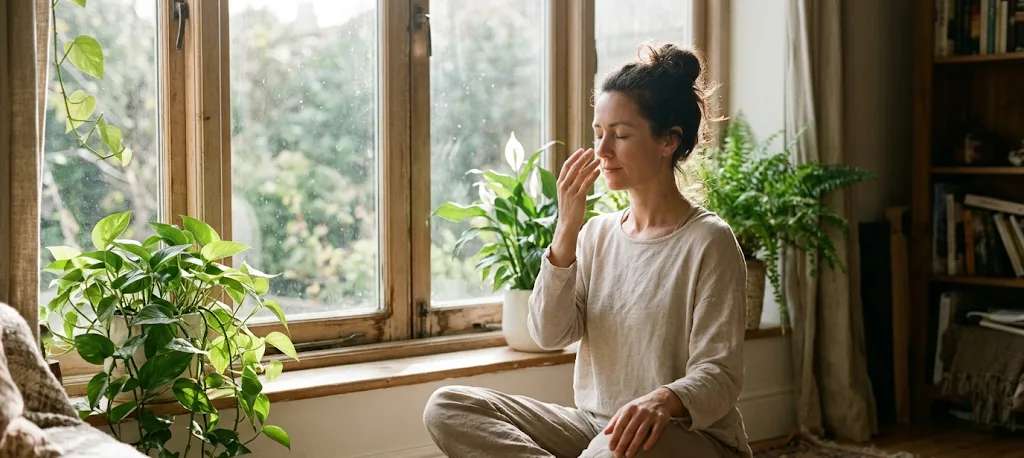
If you have ever tried to calm down by taking a deep breath and ended up more wound up than before, you are in good company. Forcing a big breath tends to feel like effort. Alternate nostril breathing gives the same instinct something gentler to do: a slow, steady rhythm, a simple hand movement, and a few quiet minutes with nothing else to think about.
This guide walks you through alternate nostril breathing for beginners, step by step. We also look at what research actually says about it, which is more modest than much of what you will read online, and who should take extra care.
The short version: alternate nostril breathing means breathing in and out through one nostril at a time, switching sides with your fingers. Start with two or three minutes, keep the breath soft and unforced, and stop if you feel dizzy. It is a relaxation habit with modest evidence, not a treatment.
Table of Contents
What alternate nostril breathing is
Alternate nostril breathing is known in Sanskrit as nadi shodhana, often translated as “channel cleansing”. It comes from yoga and Ayurvedic traditions, where breathing practices (pranayama) are treated as part of a daily routine alongside movement, food and sleep. The basic idea is simple. You close one nostril with a finger, breathe in through the other, then switch, and breathe out through the side you just closed.
There is nothing mystical about the mechanics. Slow, even breathing gives your attention a single, easy job. Many people find that this alone is enough to take the edge off a busy mind, and the hand movement keeps you from drifting off into planning tomorrow.
What the research says
Here it pays to be careful. A 2017 systematic review of 44 randomised trials looked at alternate nostril breathing across outcomes such as autonomic nervous system measures, cardiopulmonary measures and cognitive function. Most of the studies involved healthy volunteers, some were rated as having a high risk of bias, and the authors noted that the technique has many variations and has not been standardised. They called for more trials in clinical populations and for work on how often and how long to practise.
The wider picture for breathing exercises is similar. The US National Center for Complementary and Integrative Health, in its page on relaxation techniques, describes the evidence as mostly low quality or preliminary. It mentions that slow breathing produced a modest reduction in blood pressure in one 2019 review, and that there is insufficient evidence for relaxation techniques on their own for sleep, though they are sometimes one part of cognitive behavioural therapy for insomnia.
So what is a fair summary? Alternate nostril breathing is a low-cost, low-risk way to practise slow breathing, and many people find it calming. It is not a proven treatment for anxiety, high blood pressure or insomnia, and it should not replace care from a doctor.
How to do alternate nostril breathing, step by step
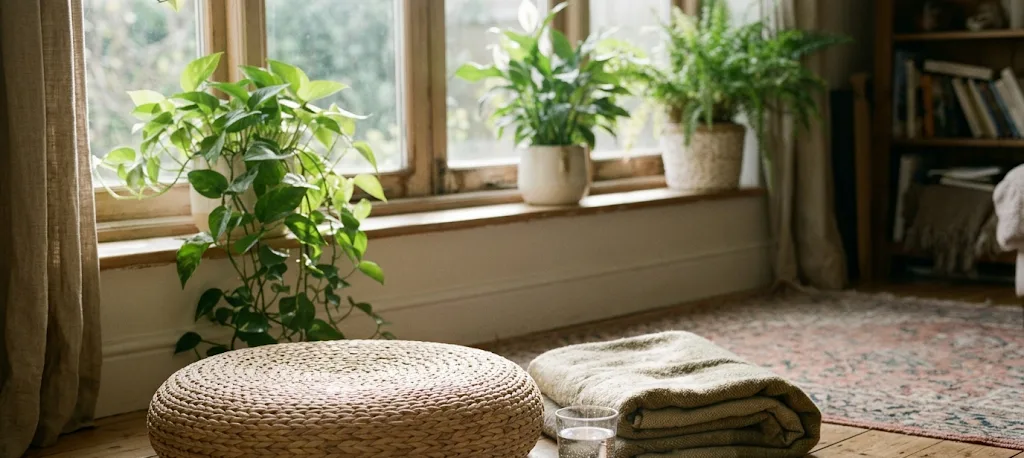
Find a quiet spot where you will not be interrupted for a few minutes. A cushion on the floor or a chair with both feet planted works equally well. You can see the sort of calm corner we mean below.
1. Sit comfortably and relax your shoulders
Keep your back long but not stiff. Rest your left hand on your left knee. Let your jaw soften and let your breathing settle for a few ordinary breaths before you start.
2. Set up your right hand
Fold your index and middle fingers gently towards your palm, or simply rest them on your forehead between the eyebrows. Your thumb will close the right nostril and your ring finger will close the left. Use a light touch. You are guiding the breath, not squeezing your nose.
3. Close the right nostril and breathe in on the left
Gently close your right nostril with your thumb. Breathe in slowly through the left nostril, to a comfortable count of about four.
4. Switch sides and breathe out on the right
Close the left nostril with your ring finger, release your thumb, and breathe out slowly through the right nostril, to a count of about four to six.
5. Breathe in on the right, then out on the left
Keeping the left side closed, breathe in through the right nostril. Then close the right with your thumb, release the ring finger, and breathe out through the left. That is one full round. Repeat for five to ten rounds, which takes around two to three minutes at a relaxed pace.
When you finish, lower your hand, breathe naturally for a few breaths and notice how you feel before you get up. If your thoughts wander, that is normal. Bring your attention back to the next breath without any fuss.
Common mistakes to avoid
- Forcing the breath. If you are straining, the breath is too big or too long. Shorten the count until it feels easy.
- Holding your breath. Some versions of the practice include breath holds. As a beginner, skip them. Keep the breath flowing smoothly.
- Pressing too hard on the nose. Close each nostril lightly. It should feel like resting a finger, not pinching.
- Practising with a blocked nose. If you are congested, wait until you can breathe through both nostrils comfortably, or breathe normally instead.
- Expecting instant results. The first few tries may feel awkward. Give it a week of short daily sessions before you judge it.
How long and when to practise
Two to three minutes is plenty to begin with. There is no single best time. Some people like it in the morning as a quiet start to the day, others use it as a pause after work, and many add it to an evening wind-down. If you want to use it at night, our ayurvedic bedtime routine shows where a few minutes of slow breathing fit alongside the rest of an evening.
For the wider picture of calming habits, see natural stress relief with Ayurveda. And if your mind simply will not stop, our guide to why overthinking never stops may help alongside the breathing.
Who should be careful
Breathing exercises are generally considered safe for healthy people, and most studies report no negative effects. The NCCIH page does note that some people report increased anxiety, intrusive thoughts or a feeling of losing control, and that relaxation techniques may rarely make symptoms worse in people with epilepsy, certain psychiatric conditions or a history of abuse or trauma. If you recognise yourself in any of that, or if you feel dizzy, light-headed or panicky, stop and breathe normally.
If you have high blood pressure, a lung condition, or you are pregnant, talk to your doctor before adding a new breathing practice. If you are on treatment for high blood pressure, keep following it. NCCIH is clear that a complementary approach should not replace the plan your provider has prescribed. And if you have severe or long-lasting anxiety or low mood, please speak to a doctor rather than relying on self-help alone.
Questions people ask
Is alternate nostril breathing safe to do every day?
For most healthy adults, a few gentle minutes a day is considered low risk. Keep the breath easy, skip breath holds, and stop if you feel unwell. If you have a medical condition, ask your doctor first.
Does alternate nostril breathing lower blood pressure?
Some small studies suggest slow breathing may reduce blood pressure modestly, and NCCIH mentions a 2019 review pointing the same way. The evidence is limited and varied, so it is not a substitute for treatment. Talk to your doctor if your blood pressure is a concern.
Can alternate nostril breathing help me sleep?
NCCIH says there is insufficient evidence that relaxation techniques alone improve sleep. They can, however, be a pleasant part of an evening routine that also covers a regular bedtime, dim lights and less screen time.
Should I breathe through the nose or the mouth?
In this practice, both the breath in and the breath out go through the nose. Keep the sound soft, almost silent. If a nostril is blocked, do not push it. Breathe normally instead and try again another day.
Further reading
- NCCIH: Relaxation Techniques: What You Need To Know
- Ghiya, S. (2017). Alternate nostril breathing: a systematic review of clinical trials. Int J Res Med Sci, 5(8)
- NCCIH: Ayurvedic Medicine In Depth
This article is for general education and is not medical advice. If symptoms persist or worry you, please speak with a qualified healthcare professional. Images on this page were created with AI.