
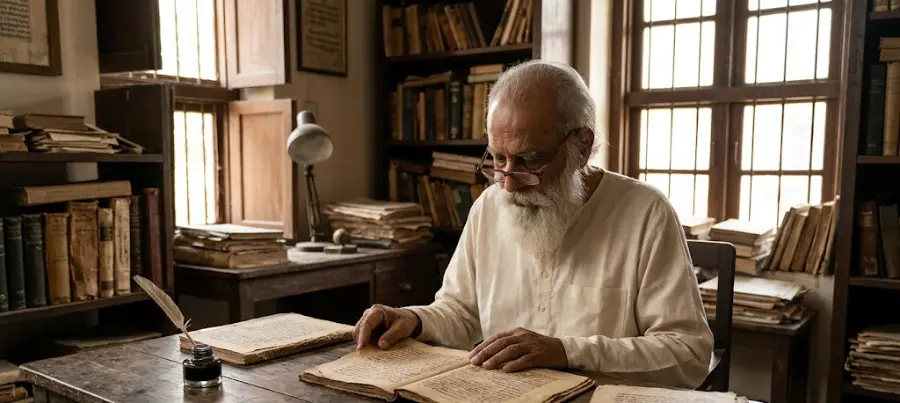
Ask ten people what the four Vedas are, and you may get ten different answers. Some say “holy books”. Some say “ancient hymns”. Others only know the names. This guide keeps it simple, clear and honest.
You will learn what each Veda contains, how the texts are arranged, why they were memorised for thousands of years, and what they can (and cannot) tell us about health today. Every section is short, so you can read it calmly on your phone.
The short version: The four Vedas are the Rigveda (hymns), Samaveda (melodies), Yajurveda (ritual formulas) and Atharvaveda (hymns for daily life, protection and healing). Scholars place their composition roughly between 1500 and 500 BCE. They are religious and cultural texts, not medical manuals, so use them for wisdom and inspiration, and use a doctor for medical care.
▶ Watch the Web Story: The Four Vedas Explained
Table of Contents
What Are the Four Vedas? Meaning and Overview
The word Veda comes from the Sanskrit root vid, which means “to know”. So the Vedas are, in simple words, the “knowledge” of the Sanatan tradition.
Hindus regard the Vedas as shruti, meaning “that which is heard”. The tradition says the sages (rishis) heard these verses in deep meditation, and then passed them on by speaking, not by writing. That is why Vedic chanting is so careful about every syllable and every tone.
There are four Vedas:
- Rigveda (the Veda of hymns)
- Samaveda (the Veda of melodies)
- Yajurveda (the Veda of ritual formulas)
- Atharvaveda (the Veda of daily life, protection and healing)
Most scholars date the oldest part, the Rigveda, to around 1500 BCE or earlier, and the full collection to somewhere before about 500 BCE. Exact dates are debated, so you will see different numbers in different books. That is normal, and it is better to say “roughly” than to pretend we know for sure.
Rigveda Explained: The Oldest Hymns
The Rigveda is the oldest and best known. It has about 1,028 hymns (suktas), grouped into ten books called mandalas. The hymns praise forces of nature and divine powers such as Agni (fire), Indra, Surya (the sun), Ushas (dawn), Vayu (wind) and Varuna.
The very first verse of the Rigveda begins with a call to fire:
अग्निमीळे पुरोहितं यज्ञस्य देवमृत्विजम्
agnim īḷe purohitaṃ yajñasya devam ṛtvijam
Rigveda 1.1.1
Meaning: I praise Agni, the priest placed first, the divine one who serves the sacrifice.
Many people love the Rigveda for its poetry. It talks about dawn, wind, rivers, rain and the wonder of creation. It even asks deep questions about where the world came from, in the famous Nasadiya Sukta (Rigveda 10.129).
Another beloved line comes from a hymn about unity (Rigveda 10.191):
संगच्छध्वं संवदध्वं सं वो मनांसि जानताम्
saṃ gacchadhvaṃ saṃ vadadhvaṃ saṃ vo manāṃsi jānatām
Rigveda 10.191.2
Meaning: Move together, speak together, let your minds be of one understanding.
Samaveda Explained: The Veda of Melodies
The Samaveda is the Veda of music. Its name comes from saman, which means “melody”. Most of its verses are taken from the Rigveda and set to special tunes for chanting at rituals.
Think of it this way: the Rigveda gives the words, and the Samaveda gives the song. Many Indian classical music traditions trace their roots back to Vedic chanting, though the link is a matter of tradition and history, not a simple straight line.
The Samaveda is the smallest of the four, with about 1,875 verses. Its first verse is a call to Agni, which also appears in the Rigveda.
Yajurveda Explained: The Ritual Words
The Yajurveda is the Veda of yajna, the sacrificial ritual. Its name comes from yajus, “sacred formula”. It contains the prose mantras that a priest speaks while performing the rituals, with exact instructions on how to do them.
It exists in two main branches. The Shukla (White) Yajurveda keeps the verses separate from their explanation. The Krishna (Black) Yajurveda mixes the verses and the commentary together.
One of its most loved verses is a wish for a long, healthy and seeing life (Yajurveda 36.24):
पश्येम शरदः शतं जीवेम शरदः शतम्
paśyema śaradaḥ śataṃ jīvema śaradaḥ śatam
Yajurveda 36.24
Meaning: May we see for a hundred autumns, may we live for a hundred autumns.
Note that this is a prayer and a hope, not a medical promise. It tells us that the Vedic people valued long, clear-sighted and active lives.
Atharvaveda Explained: Daily Life and Healing
The Atharvaveda is different in tone. It has about 730 hymns in twenty books, and it speaks about everyday concerns: health, protection, family, home, farming, peace and even grief. It also includes hymns on plants and herbs.
Because of this, the Atharvaveda is often linked in tradition with Ayurveda, the old Indian system of health. Ayurvedic texts themselves consider Ayurveda an upaveda, a “supporting Veda”, connected with the Atharvaveda (and sometimes the Rigveda). You can read more in our guide to Ayurveda and the Atharvaveda.
The Atharvaveda also contains one of the most beautiful hymns to the Earth, the Prithvi (Bhumi) Sukta, which includes this line:
माता भूमिः पुत्रोऽहं पृथिव्याः
mātā bhūmiḥ putro’haṃ pṛthivyāḥ
Atharvaveda 12.1.12
Meaning: The Earth is my mother, and I am her child.
In today’s language, that is an early call to care for nature, which is a lovely reason to read it.
How each Veda is built: four layers
Each Veda is not a single book. It is a collection with four layers, which developed over time:
- Samhita: the core collection of hymns, melodies or formulas.
- Brahmana: prose texts that explain the rituals and their meaning.
- Aranyaka: “forest texts”, which turn the ritual inward toward meditation and symbolism.
- Upanishad: philosophical texts about the self (atman) and ultimate reality (Brahman). Because they come at the end, they are also called Vedanta, “the end of the Veda”.
When someone says “I read the Vedas”, they may mean the Samhitas only, or the whole set. It helps to ask which layer they mean.
How the Vedas were passed on
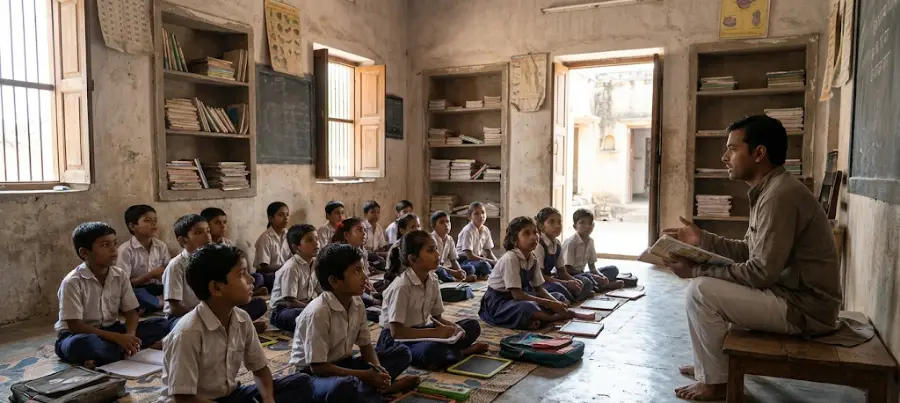
For many centuries, the Vedas were not written down in the way we write books today. A student learned from a teacher by hearing and repeating, line by line, for years. Special recitation methods (called pathas) were used to protect every word and every sound from being changed.
Because of this care, the chanting tradition survives to this day. UNESCO has recognised the tradition of Vedic chanting as part of the world’s intangible cultural heritage (inscribed in 2008). This also shows why chanting is not “just reading”. It is a trained art of breath, voice, memory and attention. We look at this more closely in our post on Vedic chanting and stress.
Short verses that are easy to remember
You do not have to learn Sanskrit to enjoy the Vedas. These short lines are easy to learn, and each one gives a calm daily thought:
- “Saṃ gacchadhvam saṃ vadadhvam”: move together, speak together (Rigveda 10.191.2). A reminder to listen and work as a team.
- “Paśyema śaradaḥ śatam”: may we see a hundred autumns (Yajurveda 36.24). A wish for a long, clear life.
- “Mātā bhūmiḥ putro’haṃ pṛthivyāḥ”: the Earth is my mother (Atharvaveda 12.1.12). A reminder to respect nature.
- “Bhadraṃ karṇebhiḥ śṛṇuyāma devāḥ”: may we hear what is good with our ears (Rigveda 1.89.8). A reminder to choose what we listen to.
The last line is part of a famous peace prayer, and we explain it in our guide to Shanti mantras. If you would like to explore the most famous Vedic verse, read the Gayatri Mantra meaning.
What the Four Vedas Teach About Daily Living
The Vedas are mostly about worship, ritual, nature and philosophy. But they also contain many ideas that people connect with a balanced life. Here are some, with a clear line between what the texts say and what we add today:
- Rising with the dawn. Dawn (Ushas) is praised again and again. Modern advice also suggests regular wake-up times, and you can read more in our Brahma Muhurta guide.
- Respect for the sun. Many hymns honour Surya. A modern practice built around this idea is Surya Namaskar, although the full sequence of postures is a more recent development.
- Sacred sound. The syllable Om, chanting and mantras are central in Vedic thought. See our post on Om chanting.
- Fire and offering. The yajna tradition uses fire and ghee. See Havan and Agnihotra for a careful look at benefits and safety.
- Care for the Earth. The Prithvi Sukta is a hymn of respect for the planet.
- Community. The Sanjnana Sukta (Rigveda 10.191) is a hymn of unity.
Vedas, Ayurveda and Modern Medicine: An Honest View
This is where we must be careful. The four Vedas are religious and philosophical works. They are not clinical textbooks, and they do not give doctors’ advice for treating disease.
Ayurveda, the traditional Indian medical system, is a separate body of later texts such as the Charaka Samhita and Sushruta Samhita. It draws inspiration from Vedic ideas. The US National Center for Complementary and Integrative Health describes Ayurveda as one of the world’s oldest medical systems and says there is little scientific evidence on its value for most health problems. It also warns that some Ayurvedic products have been found to contain toxic amounts of lead, mercury or arsenic, so be very careful with herbal products and never use them to delay seeing a doctor.
A fair, balanced approach looks like this:
- Enjoy the Vedas for their wisdom, language, poetry and peace.
- Use habits that match good health advice, such as regular sleep, movement and calm time.
- Do not use a verse or a ritual as a substitute for medical treatment.
- Check any herb or supplement with a doctor or pharmacist first.

How to Read the Vedas as a Beginner
The Vedas can feel huge. Here is an easy way to begin:
- Start with a good translation. Choose a translator who gives the Sanskrit, a word-by-word meaning and a clear explanation.
- Read one hymn at a time. Ten minutes is enough. Do not try to finish a whole book in a week.
- Begin with short, famous hymns. The Gayatri Mantra, the Purusha Sukta, the Prithvi Sukta and the Nasadiya Sukta are good starting points.
- Listen as well as read. Many recordings of traditional chanting are available. Hearing the rhythm helps you feel the text.
- Learn the context. Ask what the verse meant to the people who first used it.
- Learn from a teacher if you can. The tradition values teachers (gurus) for good reason.
Common Myths About the Four Vedas
- Myth: the Vedas are one book. They are four collections, each with several layers.
- Myth: the Vedas give exact medical cures. They are not medical manuals. The Ayurvedic texts came later.
- Myth: everything modern was already in the Vedas. Be careful with such claims. They often stretch a verse far beyond what it says.
- Myth: you must know Sanskrit to benefit. Good translations make the ideas available to everyone.
- Myth: chanting a verse heals disease. Chanting may calm the mind, but it is not a replacement for medical care.
Keeping these myths in mind will make your reading more honest and also more enjoyable.
Key Vedic Sanskrit Words in Plain English
A few words appear again and again when people talk about the four Vedas. Here they are, kept short:
- Mantra: a sacred verse or sound, meant to be repeated with attention.
- Sukta: a hymn, made up of several verses.
- Rishi: a sage, traditionally the one who “saw” a hymn.
- Yajna: a ritual offering, often made into a fire.
- Dharma: duty, right living, the way things hold together.
- Rita: the natural order of the universe, an early Vedic idea.
- Guru: a teacher who guides a student step by step.
Knowing these seven words already makes most books on the four Vedas easier to follow.
A simple Veda-inspired day
You do not need a ritual space or special clothes to take a little inspiration from the four Vedas. Here is a gentle, realistic idea for a normal day:
- Morning: wake at a steady time, stand near a window, and take three slow breaths. Think of Ushas, the dawn.
- Mid-morning: before an important conversation, remember the line “Saṃ gacchadhvam”: listen first, speak second.
- Afternoon: spend five minutes outdoors. The Prithvi Sukta is a reminder to feel connected to the ground and the sky.
- Evening: read one verse with its meaning, or listen to a few minutes of calm chanting.
- Night: switch off screens, and think of one thing you are thankful for.
None of this is a medical treatment. It is a quiet way to bring the spirit of the texts into everyday life, and it costs nothing.
If you enjoy this, the next step might be learning one mantra well. Our posts on the Gayatri Mantra and the Mahamrityunjaya Mantra are good places to continue.
Four Vedas FAQs
Which of the four Vedas is the oldest?
The Rigveda is considered the oldest. The other three build on it or add to it.
Who wrote the Vedas?
Tradition says the Vedas are apaurusheya, “not of human origin”, and that the sages heard the verses in meditation. Historians see them as the work of many poets over centuries. Both views appear in books, so it is good to know which view an author is using.
How many verses are there in the four Vedas?
Counts differ by edition. The Rigveda has about 1,028 hymns and over 10,000 verses. The Samaveda has about 1,875 verses. The Atharvaveda has about 730 hymns. The Yajurveda has around 2,000 or so verses in its main collection, depending on the branch.
Are the Upanishads part of the Vedas?
Yes. In the traditional scheme, they are the last layer of each Veda, which is why they are called Vedanta.
Can anyone read the Vedas today?
Yes. Translations in many languages are available, and many teachers welcome sincere students.
Do the four Vedas teach health habits?
They contain many ideas about balance, nature and a long life. For practical health advice, rely on modern medical guidance and use the Vedas for inspiration.
Further reading
This article is for general education and cultural information, not medical advice. If symptoms persist or worry you, please speak with a qualified healthcare professional. Images on this page were created with AI.