
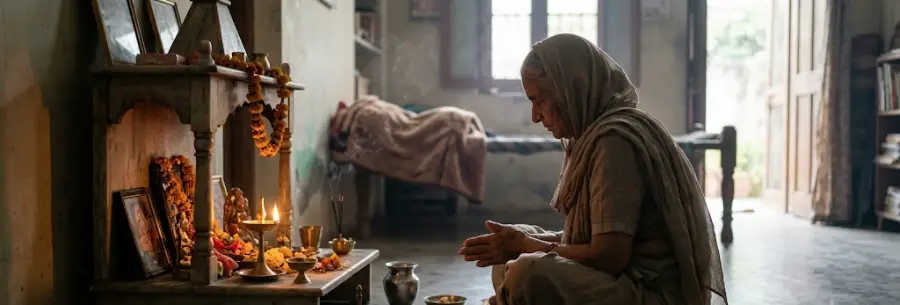
Few Sanskrit verses are as loved as the Mahamrityunjaya mantra. Families chant it when someone is unwell, before a journey, or simply at the start of a quiet morning. Searches for the Mahamrityunjaya mantra meaning come from India and from readers across the UK, the US and Europe who want to understand the words they hear.
This guide gives you the verse, a word-by-word meaning, its place in the Vedas, and a careful view of what chanting can and cannot do. We keep the spiritual meaning and the health facts clearly apart.
The short version: The Mahamrityunjaya mantra is a verse from the Rigveda (7.59.12), also found in the Yajurveda, addressed to Tryambaka, a name of Shiva. It asks for nourishment, health and release “from death, not from immortality”, which tradition reads as freedom from fear and bondage. It is a spiritual prayer. Chanting may help you feel calm, but it is not a medical treatment.
▶ Watch the Web Story: Mahamrityunjaya Mantra Meaning
Table of Contents
What Is the Mahamrityunjaya Mantra?
The name has three parts: maha (great), mrityu (death) and jaya (victory or conquest). So it is often called the “great death-conquering mantra”. It is also known as the Tryambaka mantra, after its first word.
It is a prayer for health, strength and freedom from fear. Families often chant it for the well-being of someone dear, and many people use it as a short daily prayer.
The mantra in Devanagari and transliteration
त्र्यम्बकं यजामहे सुगन्धिं पुष्टिवर्धनम् । उर्वारुकमिव बन्धनान्मृत्योर्मुक्षीय मामृतात् ॥
tryambakaṃ yajāmahe sugandhiṃ puṣṭivardhanam | urvārukam iva bandhanān mṛtyor mukṣīya māmṛtāt ||
Rigveda 7.59.12
Meaning: We worship the three-eyed one, fragrant and increasing nourishment. Like a ripe cucumber from its stem, may I be freed from death, not from immortality.
Read slowly, the verse has a gentle rhythm. Many people learn it by ear from a teacher or a family member, which is the traditional way.
Mahamrityunjaya Mantra Word-by-Word Meaning
- Tryambakam: the three-eyed one, a name of Shiva. Some traditions also read it as the “father of the three worlds”.
- Yajamahe: we worship, or we offer reverence.
- Sugandhim: fragrant, sweet-smelling, a symbol of goodness and grace.
- Pushtivardhanam: the one who increases nourishment, strength and well-being.
- Urvarukam iva: like a cucumber or ripe gourd.
- Bandhanat: from the stem, or from bondage.
- Mrityor mukshiya: may I be freed from death.
- Ma amritat: not from immortality, or from the nectar of life.
The picture is lovely: a ripe cucumber slips off its vine without effort. The prayer asks that we might be freed from the grip of fear and suffering, as gently as that.
Mahamrityunjaya Mantra in the Rigveda and Yajurveda
This mantra is found in the Rigveda, in book 7, hymn 59, verse 12. It is also repeated in the Yajurveda. If you are new to these collections, our guide to the four Vedas explains how they are arranged.
In the Rigveda, the verse is part of a hymn associated with the Maruts and with Rudra, a Vedic deity. In later tradition, Rudra became closely identified with Shiva, which is why the mantra is now so strongly connected with him. This shows how Indian tradition grows over time, while still keeping its roots in the oldest texts.

The meaning of “not from immortality”
The last phrase surprises many readers. The mantra does not ask to avoid death forever, as that would be impossible. Traditional teachers explain it in a few ways:
- Release from fear. We ask that fear of death should not rule our lives.
- Natural ripening. Like the cucumber, may we reach the right time, and leave the stem when we are ripe.
- Spiritual meaning. May we be free from the cycle of suffering, and attain what is lasting.
Whichever reading speaks to you, the sense is calm and accepting rather than fearful. It is a prayer for a good life and a peaceful end, not a promise of an escape from mortality.
How the mantra is traditionally used
- As a daily morning or evening prayer.
- During a family member’s illness, as a prayer for strength.
- Before a trip, as a prayer for safety.
- During a havan or puja, led by a priest.
- In silent repetition, using a mala of 108 beads.
These are devotional customs. People who chant often say it gives them comfort and a feeling of being supported. That is a real and valuable experience, even though it is separate from medical care.
How to Chant the Mahamrityunjaya Mantra
You can learn a simple version at home. Here is an easy method:
- Sit comfortably, in a clean and quiet place.
- Take three slow breaths and relax your shoulders.
- Listen to a recording by a trusted teacher first, so the sounds are right.
- Chant slowly, line by line, with a steady rhythm.
- Start with 9 or 11 repetitions. You can build up to 108 if it feels right.
- Finish with a few moments of silence, and a quiet thanks.
Do not worry about perfection. Teachers say sincerity matters, and you can improve your pronunciation over time.
What research says about chanting and relaxation
The NCCIH, a US government health agency, describes meditation and other relaxation techniques in its relaxation techniques overview. It says that such methods may help with stress and some health problems, and that they are generally safe for healthy people.
Chanting combines slow, rhythmic breathing, focus and a calm setting. So it is reasonable to think it can help people feel calmer. But we should be careful: there is no good evidence that chanting this particular mantra cures or prevents any disease. It is a spiritual practice that may help you feel at peace.
Mahamrityunjaya Mantra Benefits
- Calm and focus. The steady rhythm gives the mind one thing to follow.
- Slower breathing. Chanting naturally lengthens the outbreath.
- A sense of support. Prayer can be comforting in hard times.
- Routine. A regular practice gives structure to the day.
- Connection. Chanting with family can bring people together.
These are gentle, human benefits. They are valuable, but they are not a replacement for treatment.

Mahamrityunjaya Mantra for Someone Who Is Ill
When a loved one is unwell, many families chant this mantra. This can be a deep comfort for everyone. Here is a wise balance:
- Make sure the person is seeing a doctor and following treatment.
- Chant as an act of love, and not as a substitute for medical care.
- Spend time with the person, listen, and help with practical needs.
- Look after yourself too: rest, eat and talk to someone you trust.
If you are caring for someone, our guides to natural stress relief and why you may always feel tired may help you look after your own energy.
Respectful chanting tips
- Learn the words from a reliable source or teacher.
- Understand the meaning, so the chant is not only sound.
- Chant in a clean and calm space.
- Respect those from different traditions, and do not force others to join.
- Avoid using the mantra for commercial claims or “guaranteed results”.
Common mistakes
- Rushing the words, which changes the sound.
- Chanting when very tired while driving or working with machinery.
- Believing the mantra will replace medicine.
- Comparing your chanting with others. Everyone starts somewhere.
Common myths
- Myth: it makes you immortal. The verse itself says “not from immortality” in a spiritual sense. It does not promise to stop death.
- Myth: it cures serious illness. There is no evidence for this. Please seek medical care.
- Myth: only priests may chant it. Many families chant it at home.
- Myth: you must chant it 108 times. Any number you can do with attention is fine.
Mahamrityunjaya mantra meaning in simple English
If you want the Mahamrityunjaya mantra meaning in one clear sentence, it is this: “We honour the fragrant, nourishing three-eyed Lord; may we be released from fear and bondage, as a ripe cucumber is released from its vine, and may we remain connected to what is lasting.”
Notice what the mantra does not say. It does not ask for a miracle. It does not tell the listener to expect a particular result. It is a humble prayer that asks for health, nourishment and freedom from fear. This is why so many people find it comforting, whatever their circumstances.
Reading it this way also helps in a practical sense. If you chant the verse expecting a medical cure, you may feel disappointed. If you chant it for comfort, courage and calm, the verse can meet you where you are.
A closer look at the images in the verse
Vedic verses speak in pictures. The Mahamrityunjaya mantra uses two beautiful ones.
- Fragrance (sugandhi). Fragrance spreads without effort. It stands for a goodness that quietly lifts everything around it.
- Nourishment (pushti). This means growth, strength and well-being, not only of the body, but of the whole person and family.
- The ripe cucumber. A ripe fruit separates from its stem naturally and without force. The mind pictures a gentle release rather than a violent one.
When you chant, you can simply hold one of these pictures in mind. For example, imagine the smell of fresh flowers, or a ripe fruit resting in a hand. Such imagery is a gentle way to keep the attention steady, just like the guided practice in our yoga nidra guide.
How the mantra fits into Vedic chanting
The Vedic tradition cares deeply about sound. Verses were passed down by ear for many centuries, with careful attention to pitch, rhythm and pronunciation. This is one reason teachers say to learn a mantra from a teacher or a good recording.
In 2008, UNESCO recognised Vedic chanting as an Intangible Cultural Heritage of Humanity, noting how carefully it has been preserved. If you would like to know about this tradition, see our guide to Vedic chanting and stress.
You do not need to master every detail to chant at home. But taking a little care with the sounds shows respect for the verse and often helps you stay focused.
Mahamrityunjaya mantra meaning for daily life
How can an ancient verse help with modern life? Here are a few gentle ways people use it.
- At the start of the day: a short chant to set a calm tone.
- Before a hard conversation or exam: a few slow repetitions to steady the breath.
- In a period of worry: a way to give the mind something steady to rest on.
- At bedtime: a quiet chant, followed by silence, as part of a wind-down.
In each of these cases, the benefit comes from the pause, the breath and the meaning. If you often feel anxious, remember that chanting is one support among many. Good sleep, regular meals, time outdoors and talking to people you trust all help, and so can a visit to a doctor or counsellor.
Understanding Shiva and Rudra in the verse
The verse speaks to Tryambaka, who in later tradition is a name of Shiva. In the Rigveda, the deity Rudra is invoked in several hymns as a powerful and also kind figure, asking for protection and healing. Over time, Rudra and Shiva became closely linked in Indian religion.
This is an example of how living traditions grow. The same verse can be understood in the oldest layer of the Vedas, and also in the devotional life of Shaiva families today. Both understandings are part of the heritage. You do not need to pick one. You can enjoy the verse for its beauty, its history and its meaning for people who pray it.
Chanting safely and comfortably
Chanting is gentle, but a few simple precautions can make it more comfortable.
- Sit with a straight but relaxed back, on a chair if the floor is hard.
- Breathe naturally. Do not strain or hold your breath.
- Keep a glass of water nearby, especially for long sessions.
- If you feel dizzy, stop and rest.
- If a long practice causes anxiety, shorten it or speak to a trusted teacher or health professional.
As with any practice, listen to your body and mind. A short, calm chant is better than a long, strained one.
A simple 10-minute Mahamrityunjaya practice
Here is a short, calm routine you can follow at home. You do not need any special items, only a quiet corner.
- Minute 1: sit comfortably and take three slow breaths.
- Minutes 2 to 3: read the meaning of the verse once, so your mind knows what you are saying.
- Minutes 4 to 8: chant the verse slowly, 9 times, or listen to a recording and chant along.
- Minutes 9 to 10: sit in silence. Notice your breathing and the feeling in your body.
If you like, end with a kind thought for someone you love. Many people find that this brief practice gives the day a gentle start, and that the meaning of the Mahamrityunjaya mantra becomes clearer each time they repeat it.
Keep your expectations modest and your practice regular. Even a few quiet minutes, done with sincerity and care, can be a comfort in busy times.
Learning more about the mantra
If this verse has caught your interest, you might enjoy reading about two other famous mantras of the Vedic tradition: the Gayatri mantra and the sacred syllable Om. Each has its own meaning, its own place in the Vedas and its own practices.
You can also read a trustworthy translation of the whole Rigveda hymn 7.59, to see how the verse sits among its neighbours. Reading the context often adds depth to a verse you already know by heart.
Mahamrityunjaya Mantra FAQs
Which Veda is the Mahamrityunjaya mantra from?
It appears in the Rigveda (7.59.12) and is also found in the Yajurveda.
What does Tryambaka mean?
It is usually translated as “the three-eyed one”, a name for Shiva. Some teachers also explain it as the “father of the three worlds”.
Can anyone chant this mantra?
Yes. Many families chant it at home with respect.
How many times should I chant it?
Traditions mention 9, 27 or 108 repetitions. Start with a number you can do calmly.
Does chanting replace treatment?
No. Chanting may bring comfort, but it is not a medical treatment.
Further reading
This article is for general education and cultural information, not medical advice. If symptoms persist or worry you, please speak with a qualified healthcare professional. Images on this page were created with AI.