
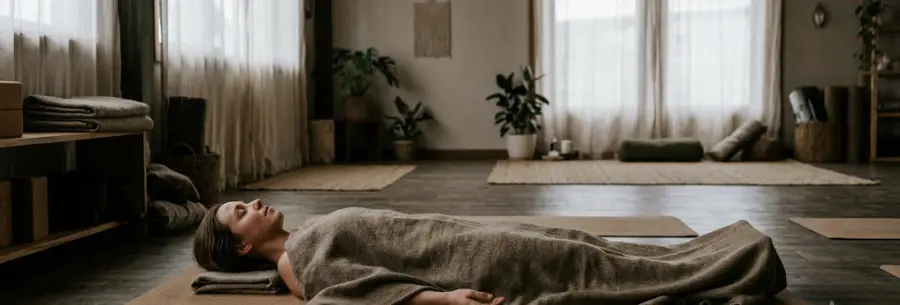
Imagine lying down, closing your eyes and being gently guided through your body while you stay awake and calm. That is yoga nidra, often called “yogic sleep”. It has become popular with people in the UK, the US and Europe who want a simple way to rest and wind down.
Is it ancient wisdom, a modern method, or both? This guide explains where yoga nidra comes from, how to practise it, and what health agencies say about relaxation methods, in plain, honest language.
The short version: Yoga nidra is a guided relaxation practice in which you lie down and move your attention through the body, breath and sensations while staying awake. Its roots are in Indian yogic and tantric ideas, and the modern form was shaped in the 20th century. Research on relaxation techniques suggests they can help with stress and sleep for many people, but yoga nidra itself needs more high-quality studies.
▶ Watch the Web Story: Yoga Nidra Benefits
Table of Contents
What Is Yoga Nidra?
In Sanskrit, nidra means sleep. But yoga nidra is not ordinary sleep. You lie still, usually on your back, and follow spoken instructions. You are deeply relaxed, yet aware.
A session often includes:
- settling into a comfortable position
- setting a short, positive intention
- moving attention through each part of the body
- noticing the breath
- observing sensations and feelings without judging
- coming back slowly
Sessions usually last from 10 to 45 minutes. You do not need to be flexible or fit, so it is open to almost everyone.
Where yoga nidra comes from
It is worth being precise here. The idea of a state between waking and sleep is old in Indian thought. But the specific practice called yoga nidra, as taught today, was developed and popularised in the 20th century, notably by Swami Satyananda Saraswati of the Bihar School of Yoga, who drew on older yogic and tantric methods.
So yoga nidra is not a practice described in the four Vedas. Its philosophical background lies in the later Upanishads and yoga traditions. If you want to know how the Vedas and Upanishads fit together, read our guide to the four Vedas.
What the Upanishads say about states of mind
The Mandukya Upanishad, one of the best known Upanishads, describes the sacred syllable Om and the states of waking, dreaming and deep sleep. It begins:
ओमित्येतदक्षरमिदं सर्वम्
om ity etad akṣaram idaṃ sarvam
Mandukya Upanishad 1
Meaning: Om, this syllable, is all this.
The Upanishad goes on to describe the different states of awareness. This way of thinking about consciousness is part of the background for yoga nidra. You can read more about the sacred syllable in our guide to Om chanting.
We say “background” on purpose. The Upanishad is not a manual for the practice. The practice is a modern way of using the idea of rest with awareness.
How a yoga nidra session works
The key is to relax the body while the mind stays gently alert. The guide, or the recording, leads you through stages. The body is relaxed part by part. The breath is noticed. Feelings are observed. At the end, you are guided back to normal waking awareness.
It is different from sleep, although some people do fall asleep, especially if they are tired. That is fine, and many people use it for exactly this reason.
How to Do Yoga Nidra: A 20-Minute Practice
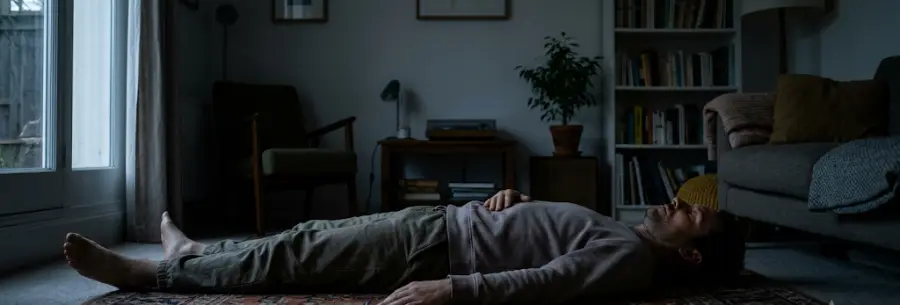
You can try this simple version at home. Use a quiet room, a mat or bed, a blanket and a pillow under your knees if it helps.
- Minutes 1 to 2: lie on your back, arms by your sides, palms up. Close your eyes. Take three slow breaths.
- Minutes 3 to 4: silently set a short, kind intention, such as “I rest and I am calm”. Keep it in the present tense.
- Minutes 5 to 12: move your attention slowly through your body: right hand, arm, shoulder, then left; right foot, leg, hip, then left; back, stomach, chest, neck, face. Spend a few seconds on each part.
- Minutes 13 to 16: notice your breath rising and falling, without changing it.
- Minutes 17 to 18: notice any feeling or thought, and let it pass like a cloud.
- Minutes 19 to 20: repeat your intention. Wiggle fingers and toes, roll to your side and sit up slowly.
What research says about relaxation
The NCCIH, a US government health agency, describes relaxation techniques, such as meditation, guided imagery and deep breathing, in its overview of relaxation techniques. It says that these methods can help reduce stress and may help with some conditions, such as anxiety, but that research quality varies and they are generally safe for healthy people.
For yoga more widely, the NCCIH gives a summary of what is known on its page about yoga, which notes that yoga may help with stress and some types of pain, and that it is generally safe when practised with care.
In plain terms: relaxation methods are low-risk and may help many people, but yoga nidra in particular has less research than yoga or meditation overall. We should say what the evidence is, and not promise too much.
Possible yoga nidra benefits
Here are the benefits people most often report, along with how much evidence supports them. Please treat them as possibilities.
- Feeling calmer. Many people report this after a session. It fits with broader research on relaxation.
- Easier falling asleep. Some people use it as a wind-down at night.
- Muscle ease. Paying attention to each part of the body can show you where you hold tension.
- A pause in a busy day. A short guided rest can be a mental reset.
- Body awareness. Noticing sensations can help you spot stress earlier.
Claims that yoga nidra cures insomnia, depression or serious disease are not supported. If you struggle with these, please see a doctor.
Yoga Nidra for Sleep
If sleep is your goal, a few simple tips help:
- Practise at the same time each evening.
- Dim the lights and silence your phone.
- Use a recording with a soft, slow voice.
- Keep the room cool and comfortable.
- Do not worry if you fall asleep. That is fine.
Combine it with a calm evening routine, such as the one in our Ayurvedic bedtime routine. If you have trouble sleeping for several weeks, speak to your doctor.
Yoga Nidra for Stress and Anxiety
Stress can make the body tense and the mind busy. Yoga nidra offers a break from both. You lie down, you are guided, and you have nothing to achieve. For many people, this is the most valuable part.
It works well with other gentle habits, such as slow breathing. Try our alternate nostril breathing guide first, then lie down for a short rest. For more ideas, see natural stress relief techniques.
Yoga Nidra for Beginners: Tips
- Start with 10 minutes, and build up.
- Use a guided recording by a trusted teacher.
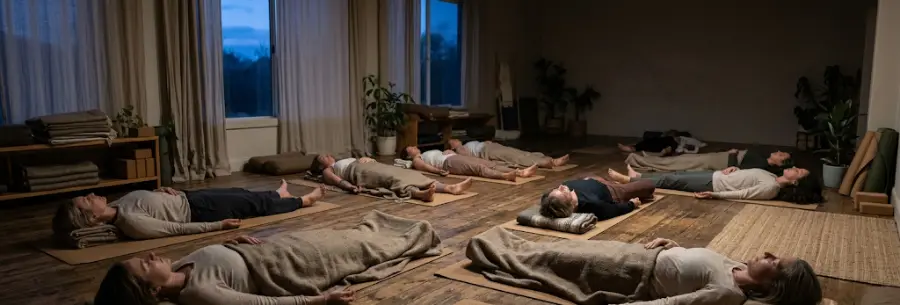
- Wear loose, warm clothes, and keep a blanket nearby.
- Do not force anything. If your mind wanders, gently return.
- Practise in a quiet place without interruptions.
- Try again tomorrow. It becomes easier with repetition.
Mistakes to avoid
- Practising while driving or doing anything that needs attention.
- Expecting instant results. Give it a couple of weeks.
- Judging yourself when you fall asleep or lose focus.
- Using it instead of medical care for serious problems.
- Trying to “do it perfectly”.
Who should be careful
Yoga nidra is gentle, but a few people should take care.
- If you have a history of trauma, or panic attacks, lying still with eyes closed can sometimes bring up strong feelings. Try a short session, with eyes open if you prefer, and speak to a professional.
- If you have severe depression or other mental health conditions, use it only as a support, alongside care from your doctor.
- If you are pregnant, lie on your side or use a pillow under your back, and ask your doctor or midwife.
- If you have back problems, place a cushion under your knees.
Common myths
- Myth: yoga nidra is from the Vedas. No. The modern practice grew in the 20th century, with older philosophical roots.
- Myth: it replaces sleep. It can help you rest, but it does not replace a full night’s sleep.
- Myth: it cures insomnia. It may help some people relax, but it is not a cure.
- Myth: you must reach a special state. You do not. Simply resting counts.
Yoga nidra benefits compared with meditation and sleep
People often ask how yoga nidra benefits differ from meditation or a nap. Here is a simple comparison.
- Yoga nidra: you lie down and follow a guide. It needs no effort to sit upright, so it is easy for beginners and for tired people.
- Meditation: usually done sitting, with attention on the breath, a sound or a thought. It can take more effort at first.
- A nap: real sleep, which restores energy, but you are not aware during it.
Each has its place. Yoga nidra sits in the middle: deeply restful, yet gently aware. Many people find it a good starting point before they try sitting meditation. If you want to try a sound-based practice next, our guide to Om chanting is a gentle next step.
How to make a calm space for practice
You do not need a studio. A few small changes at home are enough:
- Choose a room where you will not be disturbed for 20 minutes.
- Switch off notifications and put your phone on silent.
- Use a yoga mat or a firm bed, a blanket and a small pillow.
- Keep the lights soft, or use an eye cover.
- Make sure the room is warm enough, because the body cools as you rest.
If the sound of traffic or family is a problem, soft headphones with a guided recording can help. Practise at the same time each day, and the space itself will start to signal rest.
Yoga Nidra Script: A Short Body Scan to Read Aloud
If you do not have a recording, you can read a short script slowly to yourself, or ask a friend to read it for you.
“Lie down comfortably. Close your eyes. Breathe in slowly and breathe out slowly. Feel the weight of your body on the floor. Relax your forehead. Relax your eyes. Relax your jaw. Let your shoulders drop. Feel your arms heavy and warm. Feel your hands soft. Let your chest soften. Feel your stomach rise and fall. Relax your hips and legs. Feel your feet, heavy and still. Rest here for a few breaths.”
Read it slowly, leaving pauses of several seconds between lines. You can add or remove lines to suit you. The idea is simple: attention moves, and tension softens.
Building a yoga nidra habit
A habit sticks when it is small and fits your day. Try these ideas:
- Practise after lunch for a 10-minute reset, or before bed to wind down.
- Link it to something you already do, such as brushing your teeth.
- Track how you feel in a small notebook for two weeks.
- If you miss a day, simply start again.
- Invite a family member to join you.
After two weeks, ask yourself how you feel: Is it easier to fall asleep? Do you feel less tense? If you notice no change, that is fine too. Try a different time of day or a different recording.
Yoga nidra and the wider yoga practice
Yoga nidra fits well with gentle movement. A short sequence of stretches or the sun salutation (Surya Namaskar) before the lying-down rest can help the body settle. Afterwards, you can end with a few minutes of slow breathing.
The NCCIH notes that yoga is generally safe when practised with appropriate care, and that people with health conditions should talk to their healthcare provider first. If you have an injury, are pregnant, or have a long-term condition, adapt the movements and ask for advice.
In the end, yoga nidra is a modern, easy way to give yourself a pause. Used with sensible expectations, it can be a pleasant and useful part of a healthy routine.
Yoga nidra for different people and ages
Because yoga nidra is gentle, many groups can try it with small changes.
- Busy professionals: a 10-minute session after lunch can serve as a break from screens.
- Students: a short practice before study or exams can help you settle. Keep it brief.
- Older adults: lying down is easy on the joints. Use a chair if getting down is difficult.
- Parents: even five minutes while a child naps can help you recover.
- Shift workers: use it to wind down before daytime sleep.
In every case, choose a length that fits your day, and remember that regular, small practice is better than a long session once a month.
What to expect after your first few sessions
In the first week, you may feel a little restless or find that your mind keeps wandering. That is normal and not a sign of failure. By the second or third week, many people notice that settling down becomes easier and that they look forward to the quiet time.
Some people feel very sleepy after a session, while others feel light and clear. Both are common. Give yourself a minute before you stand up, drink some water, and ease back into your day.
If you ever feel dizzy, anxious or upset during a session, stop, open your eyes and breathe slowly. You can try again with a shorter session, or speak to a health professional or an experienced teacher. Your comfort always comes first.
Yoga Nidra FAQs
Is yoga nidra the same as meditation?
They are related but different. Yoga nidra is a guided practice done lying down, and meditation is often done sitting.
How long should a session be?
Between 10 and 30 minutes works for most people.
Can I do yoga nidra every day?
Yes, for most people. A daily short session can be a nice habit.
Can yoga nidra help me sleep?
It may help you relax before bed, but it is not a treatment for insomnia.
Do I need a teacher?
No. A good recording is enough for beginners, but a teacher can be helpful.
Further reading
This article is for general education and cultural information, not medical advice. If symptoms persist or worry you, please speak with a qualified healthcare professional. Images on this page were created with AI.