

Quiet streets. Cool air. A sky that is not yet blue but no longer black. If you have ever woken early and felt that the world was unusually calm, you have touched what the tradition calls Brahma Muhurta. The idea has become very popular online, and many readers search for Brahma Muhurta benefits every day.
This guide explains what Brahma Muhurta is, where the idea comes from in the Vedic and Ayurvedic tradition, what modern sleep science says, and how to try it without harming your health. We keep every section short and honest.
The short version: Brahma Muhurta is the period roughly 96 minutes before sunrise, traditionally seen as the best time for meditation and study. Its benefits rest on tradition and on the real value of a regular sleep-wake routine and morning light. Do not cut your sleep short to wake early. Most adults need seven or more hours, and consistency matters more than the exact clock time.
▶ Watch the Web Story: Brahma Muhurta Benefits
Table of Contents
What Is Brahma Muhurta? Meaning and Timing
Brahma here refers to the highest reality, or to the quality of expansion and knowledge. Muhurta is a period of time, about 48 minutes in the traditional system. So Brahma Muhurta means “the time of Brahma”, an hour that tradition associates with clarity, calm and spiritual practice.
In daily life, it is the early-morning stretch just before dawn. It is when temple bells begin, farmers start their day, and many yoga teachers say the mind is most peaceful.
Brahma Muhurta Time: How to Calculate It
Many Brahma Muhurta benefits depend on getting the timing right for your location. A common rule is that Brahma Muhurta begins about one hour and 36 minutes before sunrise and ends about 48 minutes before sunrise. In other words, it is two muhurtas, each lasting 48 minutes, before the sun comes up.
Here is a simple way to find it for your own place:
- Look up today’s sunrise time for your city.
- Subtract 96 minutes. That is the start.
- Subtract 48 minutes. That is the end.
For example, if sunrise is at 6:30 am, Brahma Muhurta runs from about 4:54 am to about 5:42 am. In summer in the UK or northern Europe, sunrise can be as early as 4:45 am, so the period would start around 3:10 am. In winter, it can be after 7:30 am. This shows why a fixed 4 am rule does not make sense everywhere, and why you should adjust to your location and your life.
What the Vedas and Ayurveda Say About Waking Early
The Vedas speak often about dawn, called Ushas, and treat it as a gift of light. The Rigveda has several hymns to Ushas. One of them begins:
इदं श्रेष्ठं ज्योतिषां ज्योतिरागाच्चित्रः प्रकेतो अजनिष्ट विभ्वा
idaṃ śreṣṭhaṃ jyotiṣāṃ jyotir āgāc citraḥ praketo ajaniṣṭa vibhvā
Rigveda 1.113.1
Meaning: This best of lights, the light of lights, has come; the bright banner of the dawn has been born.
The phrase “Brahma Muhurta” itself appears more clearly in later texts, including Ayurvedic classics. The Ashtanga Hridaya, a well-known Ayurvedic text, begins its advice on daily routine with this line:
ब्राह्मे मुहूर्ते उत्तिष्ठेत् स्वस्थो रक्षार्थमायुषः
brāhme muhūrte uttiṣṭhet svastho rakṣārtham āyuṣaḥ
Ashtanga Hridaya, Sutrasthana 2.1
Meaning: A healthy person should rise in Brahma Muhurta to protect life.
So the full picture is this. Reverence for dawn is Vedic. The specific advice to rise in Brahma Muhurta is found in later Ayurvedic and traditional texts. If you want to understand how these texts relate, see our guides to the four Vedas and to Ayurveda and the Atharvaveda.
Brahma Muhurta benefits people report
People who practise early waking often say they notice:
- a quieter environment with fewer interruptions
- a clearer mind for study, writing or prayer
- time for exercise before work
- a calmer start to the day, with less rushing
- a feeling of order and discipline
These are real experiences. Notice, though, that most of them come from quiet and consistency, not from magical properties of a particular minute. Anyone who gets up at a steady time and uses the first hour calmly is likely to feel similar things.

What science supports and what it does not
Let us look at the evidence carefully. No strong research shows that waking exactly in the Brahma Muhurta window gives special health benefits compared with waking at another time. So claims like “it cures disease” or “it adds years to your life” are not backed by science.
But several parts of the routine do match solid health advice:
- Regular sleep and wake times. The NHS advises going to bed and getting up at similar times each day, including days off, so your body learns when to sleep.
- Wind-down time. The NHS suggests using the hour before bed for calming activities such as reading, meditation or breathing exercises.
- Limiting screens before bed. The NHS advises avoiding phones, tablets and computers for an hour before bed.
- Daylight and movement. Outdoor light and activity in the morning support a steady body clock and mood.
In other words, the benefits come from the habits, not the exact clock time. See the NHS sleep advice for the full list.
The sleep question: do not trade sleep for tradition
This is the most important section in the whole article. If you go to bed at midnight and then force yourself up at 4:30 am, you are cutting your sleep. Over time, that can leave you tired, irritable and less able to concentrate. It may also affect your mood and health.
Common health guidance for adults is about seven to nine hours of sleep a night, though needs vary from person to person. The rule is simple: if you want to wake earlier, go to bed earlier. Do not wake earlier on the same bedtime.
A good test is how you feel at midday. If you are alert and calm, your routine is working. If you feel exhausted, you are probably not sleeping enough, and you should adjust.
Chronotype: are you a morning person?
People differ in their natural sleep timing. Some are “larks”, who wake early without trying. Some are “owls”, who feel best later in the day. Most are in between. Genetics, age and lifestyle all play a part.
If you are a natural owl, waking in Brahma Muhurta may be very hard. That does not mean you are lazy, and it does not mean you cannot be spiritual. You can still keep a steady, healthy routine at a time that fits your body, such as a calm half hour after you wake. The spirit of the practice, a quiet, unhurried start, matters more than the clock.
Shift workers, new parents, students during exams and people with health conditions that affect sleep should also use common sense. Your health comes first.
How to Wake Up Early Without Suffering
If you do want to try, go slowly:
- Move your wake-up time by 15 minutes every few days, not by two hours overnight.
- Move your bedtime earlier too. Protect your total sleep.
- Put your alarm across the room. This makes you stand up.
- Open the curtains, or step outside to get daylight.
- Skip caffeine late in the day. The NHS suggests limiting tea, coffee and some soft drinks.
- Avoid alcohol and large meals close to bedtime.
- Keep the bedroom quiet, dark and cool.
- Do not give up after one bad day. It takes a couple of weeks for the body clock to adjust.
Brahma Muhurta Routine: A Gentle Morning Sequence
When you wake, you do not need an hour-long ritual. A simple sequence of 20 to 30 minutes is plenty:
- Wash and drink water. Rinse your face, and have a glass of water.
- Stretch. A few minutes of easy movement. You could try a couple of rounds of Surya Namaskar.
- Breathe. Two minutes of slow breathing, or alternate nostril breathing.
- Sit quietly. Five minutes of meditation or Om chanting.
- Set one intention. Write one thing you want to do well today.
For a broader plan, see our beginner guide to an ayurvedic morning routine.
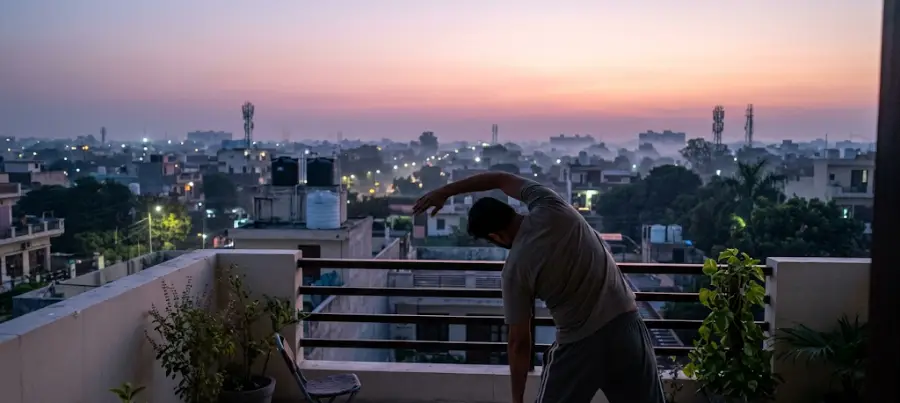
What to do in Brahma Muhurta
Tradition suggests using this time for study, prayer, meditation and quiet reflection. In modern life, it can be:
- reading a few verses, for example from a book of the Vedas or Upanishads
- chanting a mantra such as the Gayatri Mantra
- gentle yoga or a quiet walk
- journaling or planning your day
- simply sitting in silence
Whatever you choose, remember that Brahma Muhurta benefits grow with regular use. Keep the light low and your phone out of reach.
What to avoid
- Checking your phone first thing. It pulls you into the day too fast.
- Heavy exercise on an empty stomach if you feel faint.
- Cold showers if you have heart or blood pressure problems, unless your doctor agrees.
- Forcing yourself to wake when you are ill or exhausted.
- Comparing yourself with people on social media. Many “5 am clubs” posts show only the best moments.
Who should be careful
Please be careful, and talk to a doctor if needed, in these cases:
- You have a sleep disorder, such as insomnia or sleep apnoea.
- You are pregnant, or have a newborn and broken sleep.
- You have a heart condition, diabetes or take medication that needs meals at set times.
- You work night shifts.
- You have depression or anxiety, where sleep changes can make symptoms worse.
- You are a teenager. Growing bodies often need more sleep and later wake times.
Brahma Muhurta 21-Day Plan
- Days 1 to 7: wake 15 minutes earlier than now, and go to bed 15 minutes earlier. Spend the extra time in silence or a stretch.
- Days 8 to 14: move another 15 minutes earlier. Add five minutes of breathing.
- Days 15 to 21: settle at a time you can keep. Add a short mantra or journal.
At the end of three weeks, ask yourself three questions. Do I feel rested? Is my mood steady? Can I keep this up on most days? If yes, you have built a real routine. If no, adjust your timing. The best version of Brahma Muhurta benefits is the one you can keep for years.
Brahma Muhurta benefits for students, parents and workers
The idea fits different lives in different ways. Here is a realistic look at how people use the quiet hour:
- Students. A calm half hour of revision or reading before the house wakes up. Do not sacrifice sleep before exams.
- Parents. A few minutes alone before the children wake. Even ten quiet minutes can feel precious, and they show how Brahma Muhurta benefits can be small but real.
- Office workers. A short walk or stretch before the commute, so the day starts with movement and not only screens.
- Older adults. Many older people naturally wake early. A slow walk, prayer and a warm drink can make a gentle start.
- People who live in cold or dark places. In winter, wake at a time with some daylight if you can, and use a lamp and warm clothes.
The common thread is a quiet, planned start. Brahma Muhurta benefits come mainly from that quiet, and from doing it regularly, which anyone can try in a form that suits their own day.
A simple tip for dark winters and bright summers
If you live far from the equator, as many readers in the UK, Europe or the northern US do, sunrise changes a lot through the year. In summer it can be very early, and in winter very late. Trying to wake at the same clock time all year may not suit you.
- In summer, you can wake with the light but protect your sleep with an earlier bedtime and blackout curtains.
- In winter, a lamp, a warm drink and a short walk after sunrise can replace waking before dawn.
- Keep one fixed anchor: the same wake-up time on most days, which you can adjust slowly through the seasons.
The aim is a body clock that feels steady, not a rule that makes you tired.
A short reflection to end your morning
Here is a small practice to close your quiet time. Sit for a minute with your eyes closed. Think of three things: one thing you are grateful for, one thing you want to do well today, and one person you wish well. Then take a slow breath, open your eyes and begin.
This takes less than two minutes and needs no belief. It is a gentle way to carry the calm of the early hour into the busy day, and it is perhaps the most practical of all Brahma Muhurta benefits.
Brahma Muhurta FAQs
What time is Brahma Muhurta?
It starts about 96 minutes before sunrise and ends about 48 minutes before. For a 6:30 am sunrise, that is about 4:54 to 5:42 am.
Is it necessary to wake in Brahma Muhurta?
It is a tradition, not a requirement. A steady, healthy sleep routine matters more than a particular time.
Can I meditate later in the morning?
Yes. Meditation works at any time. Brahma Muhurta is simply a time many people find especially quiet.
What are the main Brahma Muhurta benefits?
People mostly report calm, focus and a sense of discipline. Scientific support is for regular sleep, morning light and a calm routine, not for the exact clock time.
How many hours should I sleep if I wake early?
Aim for the same total sleep you need, usually about seven to nine hours for adults. Go to bed earlier to match your earlier wake-up.
Does Brahma Muhurta help with weight loss or immunity?
There is no reliable evidence that the time itself does so. Good sleep, activity and food habits are what help.
Can I practise Brahma Muhurta on weekends only?
Yes. Even once or twice a week is fine. Regularity helps most, but a gentle start is better than none.
Do I need to take a bath first?
Traditional advice suggests washing before practice. For most people, rinsing the face and drinking water is enough. Do what feels comfortable and safe, and avoid cold water if it is not good for your health.
Further reading
- NHS Every Mind Matters: How to fall asleep faster and sleep better
- NHS: Physical activity guidelines for adults aged 19 to 64
- NCCIH: Ayurvedic Medicine In Depth
This article is for general education and cultural information, not medical advice. If symptoms persist or worry you, please speak with a qualified healthcare professional. Images on this page were created with AI.