

Walk into almost any traditional Indian home and you may find a small tulsi plant in the courtyard or on a balcony. It is watered every morning, circled with a prayer and treated almost like a family member. Tulsi benefits are now popular far beyond India, and holy basil tea is sold in shops across the UK, the US and Europe.
But what is true, and what is only tradition? In this guide, we explain what tulsi is, what the old traditions say, what scientific reviews have found so far, and how to use it safely.
The short version: Tulsi (holy basil, Ocimum tenuiflorum) is a sacred plant in Hindu tradition and a common herb in Ayurveda. A 2017 systematic review of human studies found promising signs for blood sugar, cholesterol, stress and mood, but the studies were small and low in quality. Tulsi tea is generally safe for most adults in normal amounts, but it is not a replacement for medical treatment.
▶ Watch the Web Story: Tulsi Benefits
Table of Contents
What Is Tulsi (Holy Basil)?
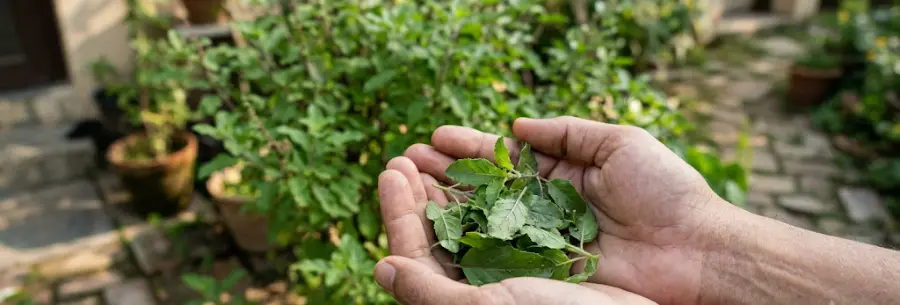
Tulsi is a leafy herb in the mint family. Its scientific name is Ocimum tenuiflorum (also called Ocimum sanctum). In English it is called holy basil, and it is different from the sweet basil you put on pizza.
It has a warm, slightly peppery, clove-like smell. There are different types, such as Rama tulsi (green leaves), Krishna tulsi (purple leaves) and Vana tulsi (wild).
Tulsi in Indian tradition
In Hindu homes, tulsi is worshipped as a form of the goddess Lakshmi, and it is closely linked with Vishnu. Many families keep a raised stand called a tulsi vrindavan in the courtyard and light a lamp near it in the evening.
Leaves are placed in water, offered with prayers and added to drinks and home remedies. It is important to say this plainly: this role of tulsi comes mainly from the Puranic and Ayurvedic traditions. It is not a main subject of the four Vedas. If you want to learn what the Vedas themselves contain, start with our guide to the four Vedas.
What the old texts say
Plants are treated with great respect throughout Vedic literature. The Rigveda has a hymn to healing plants, the Aushadhi Sukta:
या ओषधीः पूर्वा जाता देवेभ्यस्त्रियुगं पुरा
yā oṣadhīḥ pūrvā jātā devebhyas triyugaṃ purā
Rigveda 10.97.1
Meaning: The healing plants that were born, long ago, before the gods, three ages back.
This verse does not name tulsi. It shows the Vedic respect for healing plants in general. Tulsi itself is praised in the later Ayurvedic texts and the Puranas. We say this so you can trust what you read here: we do not attach verses to tulsi that are not about tulsi. Read more about this link in our guide to Ayurveda and the Atharvaveda.
What research has found
The best summary of tulsi benefits that we have is a 2017 systematic review by Jamshidi and Cohen, published in a peer-reviewed journal and available on PubMed. The authors searched for human studies of tulsi and found a small number of trials.
In general, the review reported that tulsi seemed to show promising effects in several areas:
- blood sugar and cholesterol levels
- stress, anxiety and mood
- some measures of immunity
- some inflammation markers
However, the authors also pointed out that the studies were small, short and often of low quality. They said larger, better trials are needed. So the honest conclusion is: promising, but not proven.
Possible tulsi benefits people report
Based on tradition and early studies, people list several tulsi benefits. Please read these as possibilities, not guarantees.
- Calm and mood. Many people enjoy tulsi tea as an evening drink, and early studies hint at a stress-lowering effect.
- Blood sugar. Some small trials suggest a lowering effect, but tulsi must never replace diabetes medicine.
- Throat comfort. A warm drink with tulsi and ginger is a traditional comfort for a scratchy throat, though it does not cure infections.
- Digestion. It is traditionally used after meals for a light stomach.
- Antioxidants. The leaves contain plant compounds, but that alone does not prove health effects in people.
How people use tulsi
- Fresh leaves: chewed or added to water. Some traditions say not to bite them, but there is no medical rule.
- Tea: fresh or dried leaves steeped in hot water.
- Kadha: a traditional herbal drink with ginger, pepper and tulsi.
- Powder and capsules: sold as supplements. Quality varies.
- In cooking: a few leaves in soups and chutneys.
Tulsi Tea Recipe: How to Make Holy Basil Tea
This simple recipe takes five minutes.
- Take 8 to 10 fresh tulsi leaves, or 1 teaspoon of dried leaves.
- Add a small slice of ginger, if you like.
- Pour 250 ml of hot (not boiling) water over them.
- Cover and steep for 5 minutes.
- Strain, and add a little honey or lemon if you wish.
Limit yourself to 2 or 3 cups a day. If you plan to take it every day for weeks, talk to your doctor first.

How to Grow Tulsi at Home
Tulsi is easy to grow in a warm, sunny spot.
- Choose a pot with drainage holes and a sunny window or balcony.
- Use light, well-drained soil, and keep it moist but not soggy.
- Pinch off flower buds to keep the plant bushy.
- Harvest leaves from the top, a few at a time.
- In cold places, keep it indoors in winter. Tulsi does not like frost.
Growing your own gives you fresh leaves and a small green corner at home, which many people find calming.
Tulsi Side Effects and Safety
Tulsi tea is generally considered safe for most healthy adults in normal food amounts. But supplements are different, and the long-term safety of strong extracts is not well studied. Possible issues include:
- upset stomach or nausea
- a lowering of blood sugar, which matters if you take diabetes medicine
- possible effects on blood clotting, which matters if you take blood thinners
- possible effects on hormones and fertility, which are not fully understood
The NCCIH, a US government health agency, also warns that some Ayurvedic products can contain heavy metals such as lead, mercury and arsenic. Buy from trusted brands with testing, and see their Ayurvedic medicine overview for details.
Who Should Avoid Tulsi
- Pregnant or breastfeeding women, unless a doctor says it is fine.
- People trying to conceive.
- People who take blood thinners, diabetes medicine or thyroid medicine.
- Anyone with a planned operation within two weeks.
- Anyone with a known allergy to plants in the mint family.
- Children, unless a doctor agrees.
If you are on any regular medicine, ask your doctor or pharmacist before you add tulsi supplements.
Tulsi and daily routine
Enjoying tulsi benefits can start with a small habit that fits into a healthy day. Water the plant in the morning, take a few slow breaths near it, and have a warm cup in the evening. Pair it with a calm routine, such as the one in our Ayurvedic morning routine or bedtime routine.
Sleep, food, movement and stress care do much more for health than the tulsi benefits above, and much more for health than any single herb. Tulsi works best as a pleasant extra, not a main treatment.
Common myths
- Myth: tulsi cures cancer, diabetes or COVID. No. There is no proof of this.
- Myth: more is better. Large doses of supplements have not been proven safe.
- Myth: all tulsi products are the same. Quality, dose and purity differ a lot.
- Myth: tulsi replaces medicine. It does not. Keep taking prescribed medicine.
Types of Tulsi: Rama, Krishna and Vana
You may see three main kinds of tulsi sold or grown, and the names can be confusing.
- Rama tulsi: green leaves, mild and slightly sweet. It is the most common type for tea.
- Krishna (Shyama) tulsi: purple-green leaves, stronger and more peppery. Many people prefer it for its taste.
- Vana tulsi: a wild, taller type with a lemony smell, often used in traditional remedies.
There is no strong proof that one type is healthier than another. Choose the one that tastes best to you and that you can grow or buy fresh. When you buy a packet, look for the botanical name on the label, Ocimum tenuiflorum, so you know you are getting real holy basil and not ordinary sweet basil.
Dried tulsi loses flavour with time, so keep it in a sealed jar away from light and use it within a few months.
What is inside the leaves
Tulsi leaves contain essential oils and plant compounds such as eugenol, which gives that clove-like smell, along with flavonoids and other antioxidants. Laboratory studies, in dishes and in animals, have found that these compounds have interesting properties.
It is important to be careful here. A result in a laboratory dish does not mean the same effect happens in a human body after you drink a cup of tea. This is why scientists look at human trials, and why the 2017 review we mentioned described the evidence as promising but limited.
So when you see a product claiming that tulsi “detoxes” the body or “boosts immunity” in a dramatic way, be cautious. Those words sound nice, but they are not precise, and they are not proven by good studies. A kinder and more honest way to see tulsi is as a tasty, traditional herb with some early scientific interest.
Tulsi in other herbal drinks
Tulsi mixes well with other kitchen herbs. Here are a few combinations people enjoy:
- Tulsi and ginger: a warming drink for cold evenings.
- Tulsi and mint: fresh and light, nice after meals.
- Tulsi and lemon: add lemon after steeping, so the heat does not dull its flavour.
- Tulsi and cinnamon: a gentle, slightly sweet cup without sugar.
If you already use other herbs, such as turmeric or ashwagandha, add one new herb at a time. That way, if something upsets your stomach, you know the cause.
How to buy good tulsi products
Quality matters because herbal products are not tested as strictly as medicines in many countries. A few simple checks can help:
- Choose a brand that lists the plant part and the botanical name.
- Look for third-party testing for heavy metals and contaminants.
- Avoid products that promise to cure or treat serious diseases. This is a red flag.
- Check the dose and the expiry date.
- Buy fresh plants from a trusted nursery if you want to grow your own.
The NCCIH explains that some imported Ayurvedic products have been found to contain heavy metals. A plain tulsi leaf tea from a trusted source is generally lower risk than a mixed remedy with an unclear list of ingredients.
A calm tulsi ritual for busy days
For many families, tulsi is not only a herb but a moment of pause. You do not need to follow any religious practice to enjoy a quiet routine around a plant, but you can add one if it feels meaningful to you.
- Morning: water the plant slowly and notice the smell of the leaves.
- Take three slow breaths, with your phone away.
- Evening: make a warm cup of tulsi tea and drink it sitting down.
- If you wish, say a short thanks for the day.
Small rituals like this can be a gentle way to slow down. Research on relaxation, such as the guidance from the NCCIH on relaxation techniques, suggests that slowing the breath and taking regular pauses can help many people feel calmer. Pair it with our alternate nostril breathing guide for a full five-minute reset.
Tulsi and the Indian household calendar
Tulsi is part of many festivals and family customs. On the day of Tulsi Vivah, which usually falls in the autumn after Diwali, the plant is decorated and a symbolic wedding ceremony is held. Many families light a lamp near the plant every evening, and some circle it while praying.
These customs are cultural and spiritual. They are not medical advice, and no one needs to follow them to benefit from the plant as a herb. But they tell us something helpful: for generations, people built a daily habit of looking after a green plant, and that habit itself is good for the mind. Spending a few minutes outdoors or near greenery is something many people find relaxing.
If you live in a flat or in a cold country, a small pot on a bright windowsill can keep the tradition alive in a simple, modest way.
Mistakes to avoid with tulsi
Most problems with herbs come from small, avoidable mistakes. Keep these in mind:
- Do not take large amounts of capsules or extracts without advice.
- Do not stop prescribed medicine because you started drinking tulsi tea.
- Do not give strong herbal products to young children.
- Do not use leaves from plants that may have been sprayed with pesticides.
- Do not rely on social media claims. If a post says that tulsi cures a serious disease, it is wrong.
A sensible approach to enjoying tulsi benefits is to start with a small amount, watch how you feel, and stop if you notice a rash, stomach pain or any unusual symptom. Speak with your doctor if you have any health condition or take regular medicines.
Tulsi Tea Benefits: A Simple One-Week Plan
If you would like to try tulsi in a gentle way, this plan keeps it easy and safe for a healthy adult:
- Days 1 to 2: have one small cup of tulsi tea in the evening and notice how your stomach feels.
- Days 3 to 4: if all is well, add a second cup in the morning, or add a few leaves to your soup.
- Days 5 to 7: keep to one or two cups a day, drink water, and note your sleep and mood in a small diary.
At the end of the week, decide whether you enjoy it. Whether you carry on or not, the main supports of health stay the same: regular sleep, a balanced diet, movement and time to rest. Our guide to natural stress relief techniques has more ideas to build on.
Tulsi Benefits FAQs
Is tulsi the same as holy basil?
Yes. Tulsi is the Hindi and Sanskrit name for holy basil.
Can I drink tulsi tea every day?
Most healthy adults drink 1 to 3 cups without problems, but long-term safety data is limited. Speak to a doctor if you take medicines or have a condition.
Does tulsi help with stress?
Small early studies suggest it may, but the evidence is weak. It is a pleasant, calming ritual either way.
Can I take tulsi in pregnancy?
It is best to avoid it unless your doctor approves.
Is tulsi good for diabetes?
Some small studies show lower blood sugar, but it must not replace medicine. It can also interact with diabetes drugs.
Further reading
- Jamshidi and Cohen (2017): The Clinical Efficacy and Safety of Tulsi in Humans
- NCCIH: Ayurvedic Medicine In Depth
This article is for general education and cultural information, not medical advice. If symptoms persist or worry you, please speak with a qualified healthcare professional. Images on this page were created with AI.