
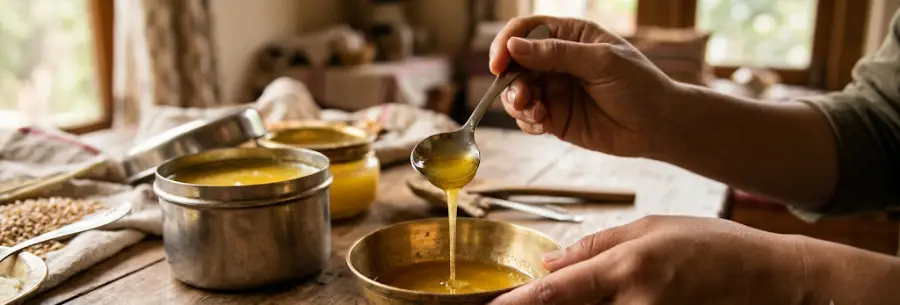
A spoon of golden ghee melting over hot dal or roti is one of the most loved sights in an Indian kitchen. For centuries it has been treated as a food for strength, a fuel for sacred lamps and a gift to the fire in ritual. Today, ghee benefits are searched by people in the UK, the US and Europe as well, and ghee is sold in many supermarkets.
So is ghee a superfood, or just a fat? In this guide, we look at the tradition, the facts on what ghee contains, and what official health guidance says, so you can decide how much to use.
The short version: Ghee is clarified butter, a rich saturated fat that is deeply valued in Indian food, Ayurveda and ritual. It tastes good, tolerates high heat and contains small amounts of fat-soluble vitamins. But it is high in saturated fat, and the NHS advises limiting saturated fat, so use ghee in small amounts and not as a health food to eat in large quantities.
▶ Watch the Web Story: Ghee Benefits
Table of Contents
What Is Ghee? Clarified Butter Explained
Ghee is a form of clarified butter. Butter is gently heated until the water evaporates and the milk solids separate. What remains is a clear golden fat with a nutty smell and a long shelf life.
In Sanskrit, ghee is called ghrita. It is used in cooking, in sweets, in lamps and in religious rituals. Because it has been used for so long, many families see it as more than food, it is part of their heritage.
How Ghee Is Made
Traditional ghee is made in a few simple steps:
- Milk is turned into curd (yoghurt), or cream is collected.
- The curd is churned to get butter.
- The butter is heated slowly in a heavy pan.
- Water bubbles off, and the milk solids sink and turn light brown.
- The clear golden fat is strained and stored in a clean, dry jar.
Because the milk solids are removed, ghee has very little lactose and casein. Some people who struggle with milk find it easier, but it is not free of milk, so people with a true milk allergy must avoid it.
Ghee in Vedic tradition
Ghee has a special place in the oldest Indian literature. The Rigveda, the oldest of the four Vedas, refers to ghrita many times, mostly in the context of the sacrificial fire (yajna), where ghee was offered into the flame. The very first hymn of the Rigveda is addressed to Agni, the fire:
अग्निमीळे पुरोहितं यज्ञस्य देवमृत्विजम् । होतारं रत्नधातमम् ॥
agnim īḷe purohitaṃ yajñasya devam ṛtvijam | hotāraṃ ratnadhātamam ||
Rigveda 1.1.1
Meaning: I praise Agni, the household priest, the divine minister of the sacrifice, the one who calls the gods and bestows treasures.
This verse does not mention ghee directly, but ghee is the traditional offering to Agni in this ritual. If you would like to know more about the hymns and the four collections, see our guide to the four Vedas and our article on havan and Agnihotra.
It is important to remember the difference between tradition and medicine. The Vedic texts honour ghee as a sacred and valuable food. They are not nutrition studies, and they do not tell us how much ghee is best for a modern heart.
Ghee Nutrition: What Is in Ghee
Ghee is almost pure fat. A tablespoon (about 13 g) gives around 110 to 120 calories. It contains:
- Saturated fat: about 60 to 65 percent of the fat, which is a high share.
- Monounsaturated fat: a smaller portion, about 25 to 30 percent.
- Butyrate: a short-chain fatty acid found in small amounts.
- Vitamins A, E and K: small amounts of these fat-soluble vitamins.
The vitamins in ghee are real, but the amounts are small when you eat a teaspoon or two. You can get vitamins A, E and K much more easily, and with less saturated fat, from vegetables, nuts and seeds.

Ghee Benefits People Talk About
Here are the usual claims, with a fair view on each one:
- Good taste and satisfaction. This one is true. A small amount adds flavour, so you may feel satisfied with less food.
- High smoke point. True. Ghee is stable at higher cooking heat than butter, so it suits frying and tempering spices.
- Easier for some people with lactose intolerance. Possibly, because the milk solids are mostly removed, but it can still cause problems for some.
- Helps absorb vitamins. Eating a little fat does help the body absorb vitamins A, D, E and K. Any healthy fat does this.
- Good for the heart, weight loss or brain. These claims are not well supported by good human studies, and because of the saturated fat, it would be wrong to call ghee heart-healthy.
Is Ghee Healthy? What the NHS Says About Saturated Fat
The NHS guidance on saturated fat is clear. Eating too much saturated fat can raise the level of cholesterol in your blood, which increases the risk of heart disease. The guidance lists foods high in saturated fat, including butter, ghee, lard, cream, cheese, fatty meat, biscuits and cakes.
The NHS gives the following general upper limits for saturated fat in a day:
- men: no more than about 30 g
- women: no more than about 20 g
- children: less than adults, depending on age
The advice also says to swap saturated fats for unsaturated fats when you can, for example vegetable oils such as olive or rapeseed oil. This is the key point for anyone who loves ghee: it does not mean you must give it up, but it should be used with thought.
How Much Ghee Per Day Is Healthy?
One teaspoon of ghee is about 5 g of fat, and about 3 g of it is saturated fat. A tablespoon is about 13 g of fat, and about 8 g is saturated. So a teaspoon or two a day uses a small share of the daily limit, while a large helping at every meal can use a big share, and that is before counting milk, cheese, sweets and snacks.
A sensible approach for most healthy adults:
- use ghee as a flavour, not as a main fat
- keep to about 1 to 2 teaspoons a day in total
- use unsaturated oils for most of your cooking
- look at your whole day, including dairy, sweets and fried foods
If you have high cholesterol, heart disease or diabetes, ask your doctor or dietitian how much is right for you.
Ghee vs Butter and Other Fats
- Ghee: rich flavour, high heat stability, high in saturated fat.
- Butter: similar fat profile, lower smoke point, contains milk solids and some lactose.
- Olive oil and rapeseed oil: mostly unsaturated fat, recommended by the NHS as a swap.
- Coconut oil: very high in saturated fat, so use sparingly.
- Mustard oil: traditional in some regions, but rules about its sale as food differ by country, so check local guidance.
No single fat is perfect for everything. Using a mix, and using less overall, is a good plan.
How to use ghee in cooking
- Use a teaspoon to temper cumin, mustard seeds and curry leaves for dal.
- Stir a little into khichdi or porridge at the end.
- Brush a thin layer on roti instead of spreading it thickly.
- Roast spices or nuts in a small amount.
- Use a measuring spoon instead of pouring from the jar.
Small steps like these keep the taste and still keep the portion modest.
How to Make Ghee at Home
Making ghee at home takes about 30 minutes and is a pleasant, simple kitchen task.
- Place 500 g of unsalted butter in a heavy pan on low heat.
- Let it melt and simmer gently. It will foam and crackle.
- Skim off the foam if you wish, and keep the heat low.
- When the sound quietens and the milk solids turn light golden at the bottom, switch off.
- Cool for a few minutes, then strain through a clean cloth into a dry jar.
Store it in a clean, dry jar with a dry spoon, away from direct sunlight. Never let water into the jar, because this can spoil it.

Ghee in a sattvic day
In the sattvic style of eating, a little ghee is considered nourishing. You can see how it fits into a full day in our guide to the sattvic diet. For example, a teaspoon on dal at lunch and a teaspoon on khichdi at dinner is a modest amount that keeps the traditional taste.
The NHS also notes that a well-planned vegetarian diet, which many ghee lovers follow, can be healthy. See the NHS page on the vegetarian diet for details on iron, B12 and calcium.
Who should be careful
- People with high cholesterol or heart disease.
- People who are overweight and trying to lose weight, since ghee is calorie-dense.
- Anyone with a diagnosed milk allergy.
- People with gallbladder or liver problems, who may be told to limit fat.
- Anyone told by their doctor to limit saturated fat.
Common myths
- Myth: ghee melts belly fat. No. It is calorie-dense, and there is no proof of this.
- Myth: ghee has no cholesterol effect. It is a saturated fat, and too much can raise cholesterol.
- Myth: more ghee means more strength. Strength comes from overall diet and activity.
- Myth: ghee is a cure for diseases. No food cures disease.
- Myth: homemade ghee has no saturated fat. It is the same type of fat.
Ghee and the Ayurvedic view
In Ayurveda, ghee is called a rasayana, a food believed to nourish the body, and it is used as a base for many traditional preparations. Ayurvedic texts describe it as suitable for many body types when used in the right amount, and as a carrier for herbs.
Modern medicine does not use these categories, and the evidence for specific Ayurvedic claims about ghee is limited. The NCCIH, a US government health agency, notes that for many Ayurvedic practices there is little high-quality research in people. For a deeper look at how the Vedic and Ayurvedic traditions connect, see our guide to Ayurveda and the Atharvaveda.
It is perfectly fine to enjoy ghee as part of your culture and taste. Just keep the portion modest, and keep your doctor’s advice first if you have a health condition.
Ghee in festivals, lamps and rituals
Ghee is more than a food. A lamp lit with ghee is a part of daily prayer in many homes, and ghee is poured into the fire during a havan. On festivals, sweets such as laddoo, halwa and kheer use it generously.
These are traditions with deep meaning for families, and there is no need to give them up. The sensible idea is to enjoy festival sweets as occasional treats, and to keep daily meals lighter. A festival does not change your whole diet.
Using ghee in the lamp, for example, adds nothing to your calories at all, so you can enjoy the ritual completely.
How to store ghee so it stays fresh
Ghee lasts a long time because it has almost no water, but poor storage can still spoil it. Follow these steps:
- Keep it in a clean, dry, airtight glass or steel jar.
- Use a dry spoon every time. Moisture is the main enemy.
- Store it in a cool, dark cupboard. Refrigeration is not required but can extend its life.
- Discard it if it smells sour or bitter, or if mould appears.
- Check the best-before date on shop-bought ghee.
A good jar of ghee, stored well, can last several months, so you can buy in small amounts and use it with care.
Smart ways to enjoy ghee and stay balanced
The best way to enjoy ghee benefits is to think of it as a flavour boost. Here are a few easy ideas to keep your plate balanced:
- Fill half your plate with vegetables and fruit.
- Add pulses, such as dal or chickpeas, for protein and fibre.
- Choose wholegrain roti or brown rice, and finish with a small teaspoon of ghee on top.
- Use olive or rapeseed oil for everyday frying, and save ghee for tempering and finishing.
- Walk for 20 to 30 minutes after meals when you can.
This approach lets you keep the taste you love and still follow the spirit of the NHS advice.
Reading labels when you buy ghee
Not every jar is the same. When you buy ghee from a shop, take a moment to read the label.
- Look for “100% milk fat” or “pure cow ghee” or “pure buffalo ghee”.
- Check the nutrition panel for saturated fat per serving.
- Avoid products with added oils, colours or flavours unless you want them.
- Prefer brands that show a batch number and a best-before date.
If the price looks far too cheap, the product may be mixed with cheaper fats. A trusted brand or a local dairy you know is usually a safer choice. Homemade ghee from good unsalted butter is another reliable option.
A few kitchen tips from tradition and science
Many grandmothers share simple rules about ghee, and some of them match modern advice nicely. Here are a few worth keeping.
- Warm, not hot: do not overheat ghee until it smokes. Smoking fat can create harsh smells and irritating fumes, so keep the flame moderate.
- Measure it: a measuring spoon takes a few seconds and protects you from pouring far more than you intended.
- Pair it with fibre: ghee with dal, vegetables and wholegrains makes a balanced plate, rather than ghee with white bread and sugar.
- Taste first: try your dish before adding more. Often a very small amount is plenty.
These habits are easy and free. They let you enjoy the flavour that ghee brings to a meal while keeping your health in mind, and that is the heart of a balanced approach to ghee benefits.
Ghee Benefits FAQs
Is ghee healthy?
In small amounts, it can be part of a balanced diet. It is high in saturated fat, so it should not be eaten in large quantities.
Is ghee better than butter?
They have a similar fat profile. Ghee has a higher smoke point and less lactose, but it is not meaningfully healthier.
Can I eat ghee every day?
Many people do, in small amounts. Keep it to a teaspoon or two and keep an eye on your total saturated fat.
Does ghee help weight loss?
There is no good proof that it does. It has about 120 calories a tablespoon.
Is ghee safe in pregnancy?
Small amounts as part of normal cooking are common. Ask your doctor or midwife about your overall diet.
Further reading
This article is for general education and cultural information, not medical advice. If symptoms persist or worry you, please speak with a qualified healthcare professional. Images on this page were created with AI.