
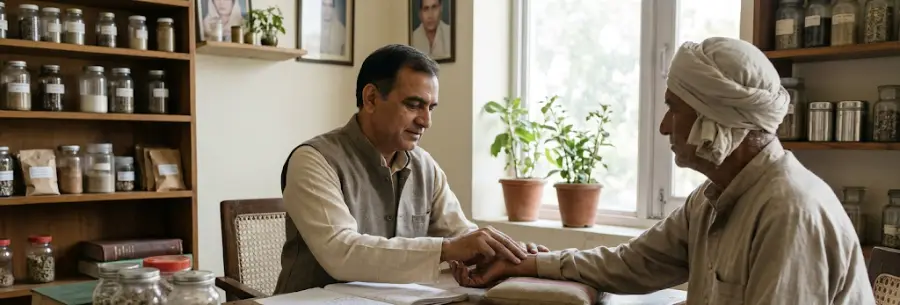
Ayurveda is one of the oldest systems of health care still in use. In India it is part of everyday life, from a pinch of turmeric in warm milk to a seasonal diet. Searches for the link between Ayurveda and the Atharvaveda are growing in the UK, the US and Europe, as more people look for the roots of this tradition.
In this guide, we explain where Ayurveda comes from, how it connects to the Vedas, what its main ideas are, and what modern research and health agencies say about it. We keep the tradition and the science clearly separate, so you always know which is which.
The short version: Ayurveda is a traditional Indian system of health that is linked in tradition with the Atharvaveda, which contains early hymns on healing and plants. Its classical texts, such as the Charaka Samhita and Sushruta Samhita, came later. Some of its lifestyle advice matches modern guidance, but there is little high-quality evidence for most of its treatments, and some products have been found to contain heavy metals.
▶ Watch the Web Story: Ayurveda and Atharvaveda
Table of Contents
What Is Ayurveda? Meaning and Origins
The word Ayurveda comes from two Sanskrit words: ayus, meaning life, and veda, meaning knowledge. So it means “the knowledge of life”.
The system covers food, daily routine, seasonal habits, herbs, massage, cleansing methods and the care of the mind. It treats health as a balance between body, mind and surroundings, not only the absence of disease.
Where Ayurveda comes from
According to the US National Center for Complementary and Integrative Health (NCCIH), Ayurveda began in India more than 3,000 years ago and is still widely used there. You can read their overview on the NCCIH Ayurvedic medicine page.
In the Indian tradition, Ayurveda is called an upaveda, a secondary or supporting branch of knowledge, and it is most often linked with the Atharvaveda. It is worth remembering that this link comes from tradition. The Atharvaveda is a collection of hymns, and Ayurveda as a full medical system, with its detailed texts, took shape over later centuries.
The Atharvaveda and Healing
The Atharvaveda is the fourth of the four Vedas. If you are new to the four collections, our guide to the four Vedas explains each one in simple words.
Compared with the other Vedas, the Atharvaveda includes much more about daily life: prayers for health, long life, safe childbirth, protection and peace. It also includes hymns about the earth, where one of the best known verses says:
माता भूमिः पुत्रोऽहं पृथिव्याः
mātā bhūmiḥ putro’haṃ pṛthivyāḥ
Atharvaveda 12.1.12
Meaning: The Earth is my mother, and I am her child.
This verse expresses a caring attitude to nature that runs through Indian tradition. Some Atharvaveda hymns are charms and prayers for healing. Scholars describe them as an early stage in Indian thinking about illness, mixing prayer, ritual and plant knowledge. They should be read as early religious and cultural texts, not as medical instructions for today.
Healing plants in the Rigveda
The Rigveda also honours plants. One hymn, called the Aushadhi Sukta, is addressed to the healing herbs:
या ओषधीः पूर्वा जाता देवेभ्यस्त्रियुगं पुरा
yā oṣadhīḥ pūrvā jātā devebhyas triyugaṃ purā
Rigveda 10.97.1
Meaning: The healing plants that were born, long ago, before the gods, three ages back.
This hymn shows how much respect early Indian people had for the plant world. We can enjoy the beauty of the verse and the respect it shows for nature, without claiming that it proves any particular herb works.
The classical Ayurvedic texts
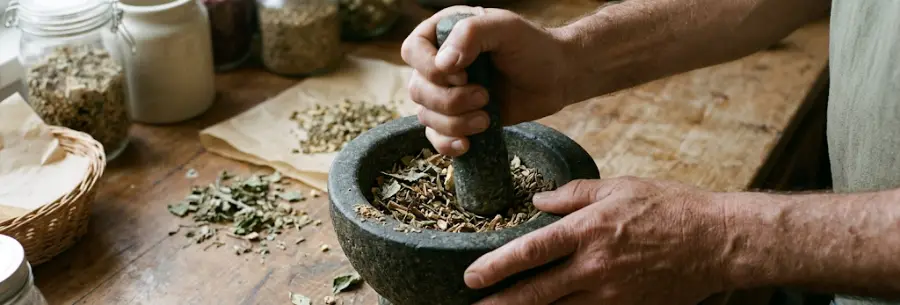
The main Ayurvedic works were written later than the Vedas. Two of the most important are:
- Charaka Samhita: focused on internal medicine, diet, daily living and the physician’s ethics.
- Sushruta Samhita: known for its discussion of surgery, instruments and wound care.
- Ashtanga Hridaya: a later text that gathers the teachings in a clear, practical form.
A famous line from the Ashtanga Hridaya, for example, gives advice about waking early:
ब्राह्मे मुहूर्ते उत्तिष्ठेत् स्वस्थो रक्षार्थमायुषः
brāhme muhūrte uttiṣṭhet svastho rakṣārtham āyuṣaḥ
Ashtanga Hridaya, Sutrasthana 2.1
Meaning: A healthy person should rise in the Brahma muhurta to protect their life.
You can read more about this idea in our guide to Brahma muhurta.
Vata, Pitta and Kapha: The Three Doshas
A central idea in Ayurveda is that three forces, called doshas, shape the body and mind:
- Vata: linked with movement, such as breathing and circulation.
- Pitta: linked with heat and change, such as digestion.
- Kapha: linked with structure and steadiness, such as the body’s moisture and strength.
Ayurveda says each person has a unique mix, and health depends on balance. This is a traditional framework. Modern science has not confirmed the doshas as measurable body systems, so treat them as a way of thinking, not a diagnosis. If you are curious, you can use the ideas for reflection, but do not use a dosha quiz to decide on medical treatment.
Ayurvedic Daily Routine: Daily Living in Ayurveda
This is where Ayurveda is often at its most useful. Many of its daily suggestions are simple and match common health advice:
- wake up at a regular time and wash with warm water
- eat freshly cooked, balanced meals and avoid overeating
- take a short walk after meals
- keep a regular bedtime and a calm evening
- spend time outdoors and watch the seasons
- take quiet time for breathing or meditation
You can start with our guides to the Ayurvedic morning routine, the Ayurvedic bedtime routine and an Ayurvedic daily routine for immunity.
Is Ayurveda Scientifically Proven? What Research Says
The NCCIH is direct about the evidence. It says that there have been few well-designed studies of Ayurvedic treatments, and that much of the research has been of limited quality. It does mention a 2013 trial in people with knee osteoarthritis, which found that an Ayurvedic treatment was similar to glucosamine in easing symptoms, but this is a single result and cannot be generalized to everything.
In plain words: some lifestyle ideas are sensible, but most Ayurvedic treatments are not proven. That does not make the tradition worthless. It means we should enjoy the culture and the healthy habits, and still ask for evidence before we trust a treatment.
Ayurvedic Medicine Safety: Heavy Metals and Quality
This is the most important section for anyone buying Ayurvedic products. The NCCIH warns that some Ayurvedic medicines, especially those made by traditional methods that use metals and minerals, have been found to contain lead, mercury and arsenic. These metals can be harmful, especially to children and in pregnancy.
To reduce the risk:
- Buy products from reputable makers that test for contaminants.
- Be careful with products bought from unknown online sellers.
- Tell your doctor about any herbal product you take.
- Do not give such products to children or use them in pregnancy without medical advice.
- Stop and see a doctor if you feel unwell after taking a product.

Using Ayurveda wisely with modern medicine
Ayurveda can sit alongside modern health care when used with care. A balanced approach looks like this:
- See a doctor first for any new, serious or lasting symptom.
- Keep taking prescribed medicine unless your doctor tells you to stop.
- Use food, routine and gentle habits as a support, not a replacement.
- Ask your doctor or pharmacist before you add any herbal product, because some herbs interact with medicines.
- Be wary of anyone who promises a cure for a serious disease.
Simple habits you can start today
- Drink a glass of warm water in the morning.
- Eat your main meal at midday, and a lighter dinner earlier.
- Sit down to eat, and chew slowly.
- Add fresh vegetables and pulses to your plate.
- Walk for 10 minutes after a meal.
- Breathe slowly for three minutes before bed.
Our guides to natural stress relief and daily energy without caffeine give more ideas.
Common myths
- Myth: Ayurveda is completely natural, so it is always safe. Not true. Some products contain heavy metals.
- Myth: Ayurveda cures all diseases. No health system does.
- Myth: the Atharvaveda is a medical textbook. It is a collection of hymns that includes early healing ideas.
- Myth: you must follow every rule. A few steady habits are enough.
How Ayurveda and Atharvaveda are connected in tradition
When people say Ayurveda and Atharvaveda belong together, they usually mean three things. First, the Atharvaveda contains hymns about health, long life and healing plants. Second, Indian tradition lists Ayurveda as an upaveda attached to it. Third, both reflect the same attitude: health is part of a larger harmony between a person, society and nature.
Scholars, however, point out that Ayurveda and Atharvaveda are not the same body of knowledge. The Atharvaveda is a book of hymns and rituals. Ayurveda, as a detailed medical system with diagnosis, diet, medicines and surgery, is described in later texts such as the Charaka Samhita and the Sushruta Samhita. So the link is real in tradition, but it is a link of inspiration and heritage, not of a single manual.
The Eight Branches of Ayurveda
Classical texts divide Ayurveda into eight branches, often called the ashtanga. In simple words they are:
- General medicine (adult health and illness).
- Paediatrics and care of children.
- Treatment of mental and spiritual problems.
- Diseases of the eyes, ears, nose and throat.
- Surgery.
- Toxicology, or the treatment of poisons.
- Rejuvenation and care in older age.
- Reproductive health and vitality.
This list shows that early Indian physicians thought widely about the whole of life. Today, some of these topics are covered by modern medicine in far greater detail and with strong evidence, so a person with a serious problem should go to a qualified doctor first.
The role of food in Ayurveda
If you take only one thing from Ayurveda, let it be this: food comes first. The tradition teaches that what we eat, how we cook it and how we eat it shape our health. You will find ideas such as:
- eat when hungry and stop before you are full
- prefer warm, freshly cooked food
- include six tastes in a day: sweet, sour, salty, bitter, pungent and astringent
- eat according to the season
- avoid eating in a hurry or while upset
Many of these tips agree with common nutrition advice: plenty of vegetables, pulses and wholegrains, and less ultra-processed food. See our guide to the sattvic diet for a practical example, and our article on ghee for an example of where tradition and modern advice need balance.
Mind, sleep and breath in Ayurveda
Ayurveda does not separate the body from the mind. It teaches that good sleep, calm breathing and a settled mind support health. These are also strong themes in modern research on stress, where relaxation practices such as meditation and slow breathing are commonly recommended by health agencies.
You can try a simple evening practice: switch off screens an hour before bed, have a light dinner, take a short stroll, and spend five minutes on slow breathing, for example with our alternate nostril breathing guide. Over time, such small steps can improve how you feel. They are far more reliable than any exotic remedy.
If sleep problems or low mood last for weeks, speak to a doctor. Ayurvedic routines can support you, but they should not delay proper care.
Why the Ayurveda and Atharvaveda link still matters today
The link between Ayurveda and Atharvaveda matters because it reminds us how deep and long the Indian interest in health has been. It shows a culture that looked at plants, food, breath and daily habits as parts of one picture.
At the same time, it teaches us to read old texts honestly. A beautiful hymn to the healing plants is not a clinical trial. A traditional remedy that has been used for centuries may still be unsafe or untested. The best way to respect tradition is to learn it carefully, enjoy its wisdom, and use modern evidence to keep ourselves safe.
If you want to explore further, start with the original idea of the four collections in our guide to the four Vedas, then try one small habit from the routines above for a week and see how you feel.
Questions to ask before trying an Ayurvedic product
Before you buy or try any herbal or Ayurvedic product, take a minute to ask yourself a few simple questions.
- Who made it, and can I find the company’s name and address?
- Does the label list every ingredient and the plant parts used?
- Has it been tested for heavy metals and contaminants?
- Is it promising to cure a serious disease? If so, avoid it.
- Could it interact with a medicine I take?
- Have I asked my doctor or pharmacist?
If you cannot answer these questions, choose another product or skip it. Your health is worth more than a trend.
A reading list for curious beginners
If this subject interests you, a gentle path is to read in this order. Begin with an introduction to the four Vedas and what each contains. Next, read a short, reliable translation of the Aushadhi Sukta (Rigveda 10.97) and a few hymns of the Atharvaveda, such as the hymn to the Earth. After that, look at a modern, readable overview of Ayurveda by a trusted health body such as the NCCIH.
Finally, try a small experiment in your own life: one week of regular sleep and meals. Note how you feel. This small test teaches you more about the practical side of Ayurveda than any long argument.
Ayurveda and Atharvaveda FAQs
Is Ayurveda part of the Vedas?
In tradition, it is called an upaveda connected to the Atharvaveda, but the full Ayurvedic texts were composed later.
Is Ayurveda scientifically proven?
Some lifestyle advice agrees with modern guidance, but there is little high-quality evidence for most treatments.
Is Ayurveda safe?
Gentle habits such as routines and food are low risk. Products, especially mineral-based ones, can be risky if not well tested.
Can Ayurveda replace my doctor?
No. Use it as a support, and see a doctor for medical problems.
What is the best way to start?
Start with routine: regular sleep, fresh meals, a morning walk and a calm evening.
Further reading
This article is for general education and cultural information, not medical advice. If symptoms persist or worry you, please speak with a qualified healthcare professional. Images on this page were created with AI.