
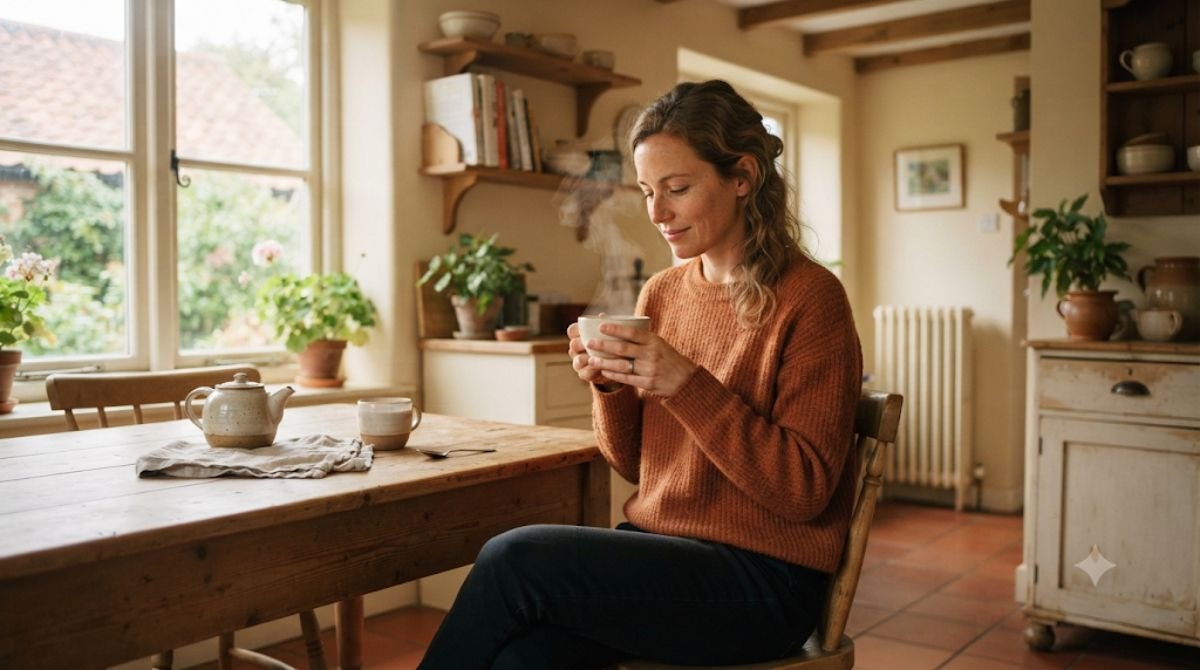
If you are looking for mindfulness for beginners, here is the short answer: mindfulness means paying attention, on purpose, to what is happening right now, and noticing your thoughts and feelings without judging them. You can start with one minute of feeling your breath, or by noticing the taste of your first sip of tea. No special equipment or belief is needed.
This guide explains what mindfulness is, how it differs from meditation, simple ways to practise in daily life, what the research says and how strong it is, and what to watch out for. It also looks at a verse of the Bhagavad Gita about training a restless mind. It is written for general education. It is not medical advice.
The short version
- Mindfulness is paying attention to the present moment, inside and outside you, without judging it, as the NHS and NCCIH describe it.
- You can practise during ordinary activities such as eating, walking or washing up. Formal sitting practice is optional.
- Thoughts are mental events. You can notice them come and go without having to obey them.
- Research suggests it may help with stress, anxiety and low mood, but much of the evidence is early or mixed.
- It is not right for everyone. If it leaves you feeling worse, stop and speak with a qualified professional.
Table of Contents

What mindfulness actually is
Mindfulness is a way of paying attention. The NHS describes it as noticing, moment by moment, what is happening inside you and around you. That includes body sensations, thoughts, feelings, and the sights and sounds of your surroundings.
The US National Center for Complementary and Integrative Health (NCCIH) uses a similar idea. It describes mindfulness as keeping attention on the present moment without making judgments.
The NHS adds a helpful point: thoughts are mental events, and they do not have to control you. You can see a worry arrive, notice it, and let it pass, instead of following it wherever it goes.
That is the whole idea. Everything else, the courses, the apps and the books, are different ways to practise it.
Mindfulness and meditation: what is the difference?
The two words are often used together, which makes them confusing. Think of mindfulness as the quality of attention, and meditation as one way of training it.
NCCIH describes meditation as a group of practices that integrate mind and body to calm the mind and support well-being. Mindfulness meditation is one type, in which you sit quietly and rest your attention on the breath, on sounds or on the body, returning each time your mind wanders.
Mindfulness itself can also happen without sitting down. You can be mindful while you walk to the shop or drink a glass of water. If you want a step-by-step sitting routine, see our guide on how to meditate for beginners.

Mindfulness for beginners: simple ways to practise in daily life
The NHS suggests starting with everyday moments. You do not need to add a new task to your day. You only need to bring a little more attention to something you already do.
Here are the ideas it describes, in our own words.
- Notice routine sensations. While eating, notice taste and texture. While walking, feel the air on your skin and your feet on the ground.
- Pick a regular moment. Choose a time you already have, such as your commute or a lunchtime walk, and use it to notice your surroundings.
- Try something new. Sit in a different seat, or take another route. Novelty makes it easier to see things freshly.
- Watch your thoughts. Let worries come and go without trying to push them away. Some people silently name them, for example, “this is anxiety”.
- Come back to now. When you notice you are dwelling on the past or worrying about the future, gently return your attention to the present.
None of these takes more than a minute. The skill is in remembering to do them, and in returning kindly when you forget.
A five-minute breathing practice
If you would like a short formal practice, try this one. It follows the breath-focused approach that the NHS describes.
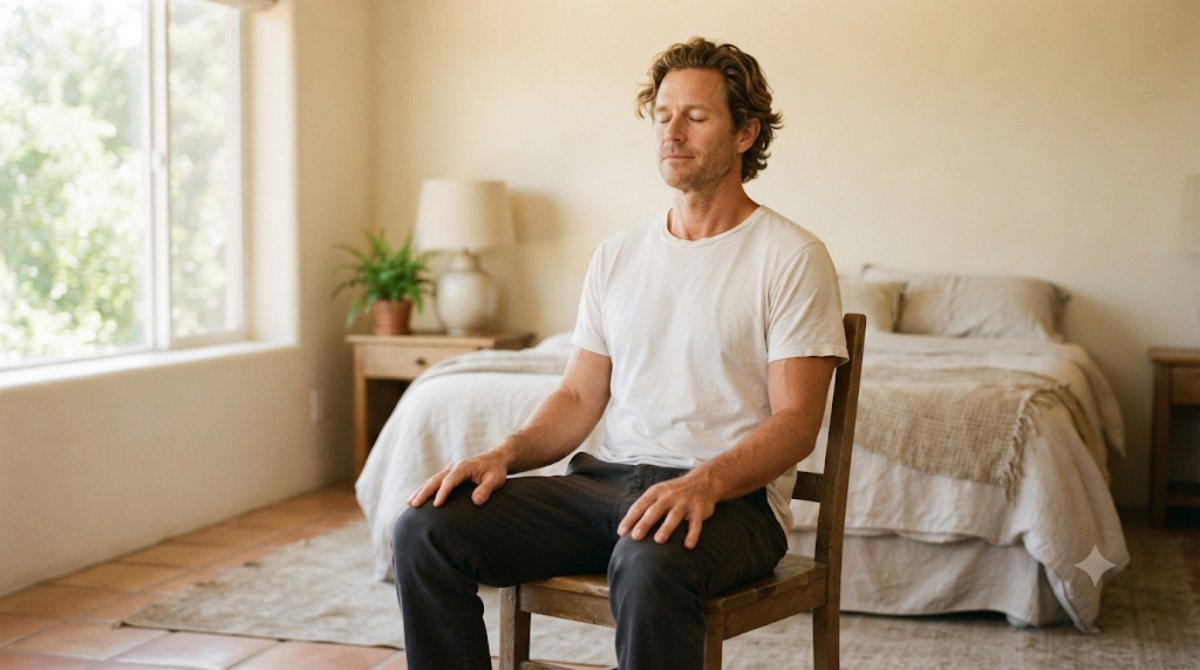
- Sit comfortably. A chair is fine. Let your hands rest in your lap.
- Set a timer for five minutes. A soft alarm means you will not keep checking the time.
- Notice your breath. Feel the air at your nostrils, or the rise and fall of your belly. You do not need to change it.
- Expect your mind to wander. It will. Planning, remembering and worrying are normal.
- Notice, then return. The moment you realise your mind has wandered is the practice. Bring attention back to the breath, without scolding yourself.
- Finish slowly. When the timer sounds, take a breath, look around the room and carry on with your day.
You may find that the practice feels easy on some days and restless on others. Both are normal. The aim is not to feel calm. The aim is to notice what is there.
Mindful eating and mindful walking
Eating and walking are two of the easiest places to start, because you do them anyway. The NHS mentions both as examples of everyday awareness.
For mindful eating, take the first few bites slowly. Notice the colour, the smell, the texture and the taste. Put your fork down between bites if that helps. You are not trying to eat less or more. You are only paying attention.
For mindful walking, feel your feet touching the ground. Notice the air on your skin and the sounds around you. If your mind drifts to your to-do list, note it and return to your steps.
These small practices do not need a quiet room. They fit into a busy day, which is exactly why many people find them easier to keep up than a long sitting practice.

What the research says, and how strong it is
Mindfulness has been studied a great deal, and the results are encouraging but mixed. NCCIH gives a careful summary, and it is worth reading closely.
| Area | What NCCIH reports | How strong it looks |
|---|---|---|
| Anxiety, depression, stress in diagnosed groups | A 2018 analysis of 142 groups found mindfulness better than no treatment and about as effective as CBT or antidepressants | Stronger evidence |
| Anxiety disorders | A 2021 analysis of 23 studies found mixed short-term results, with few lasting effects after two months | Moderate, with caveats |
| College students | A 2019 analysis found some effect, but most studies were of poor quality | Weak |
| Sleep | A 2019 analysis of 18 studies found better sleep quality than education-based treatments, but similar results to CBT or exercise | Moderate |
NCCIH also says that much of this research is preliminary or limited in design, and that results may be overly optimistic. The NHS says studies suggest mindfulness can help with stress, anxiety and depression, and that more research is needed for other mental health conditions. It also notes that NICE recommends mindfulness-based therapies for less severe depression.
The honest summary is this: mindfulness may help some people, in some situations, and it is not a cure. It is one tool among several.
Safety and who should be careful
NCCIH says meditation and mindfulness are usually considered low risk, but few studies have measured harm, so safety cannot be stated with certainty. A 2020 review of 83 studies found that about 8 percent of participants had a negative experience, with anxiety and depression the most common. That rate was similar to psychological therapies.
The NHS says mindfulness is not right for everyone. Some people find it does not help, or that it makes them feel worse.
If you have a history of trauma, severe anxiety or depression, it can be wise to start with a trained teacher or to speak with your doctor first. NCCIH advises asking about an instructor’s training and experience. It also warns against using mindfulness to replace regular care or to delay seeing a health professional.
If a practice leaves you more distressed, stop. You are allowed to stop. Speak with a GP or mental health professional.
Training a restless mind in the Bhagavad Gita
The old Indian texts speak openly about how hard it is to steady the mind. In the Bhagavad Gita, chapter 6, verse 35, the Sanskrit begins asamshayam maha-baho mano durnigraham chalam. In plain words, the teacher agrees that the mind is restless and hard to hold.
The verse goes on to say that it can still be brought under control through two things: abhyasa, steady practice, and vairagya, a loosening of attachment. You can read this as a reminder that a wandering mind is not a personal failure. Training takes repetition.
This is a teaching from the Gita, not a medical claim. It does not say that any practice treats a condition. But the fit with modern mindfulness is easy to see. Notice the wandering, return gently, and repeat. That is practice, in both traditions.
Mindful moments during a busy working day
Many people say they have no time for mindfulness. The good news is that it can fit inside the gaps of a working day. The NHS notes that NICE suggests employers offer mindfulness to staff, which shows how often it is used in work settings.
Try a one-minute pause before you open your email. Feel your feet on the floor and take three slow breaths. When you start a task, notice what your body feels like, and whether your shoulders are tense.
Use transitions as cues. Each time you walk through a door, take one deliberate breath. Each time you wait for a kettle or a lift, look around and notice three things you can see.
At the end of the day, take two minutes to notice how you feel. You do not need to fix anything. You are simply checking in with yourself.
If your work is the main source of your stress, mindfulness will not remove the cause. Our guide to burnout symptoms explains what public health sources suggest when stress becomes constant. Short pauses are a support, not a substitute for a manageable workload.
Building a habit that lasts
Most beginners stop because they aim too high. A shorter plan is easier to keep.
- Start with two minutes a day, at the same time and place.
- Link it to a habit you already have, such as after brushing your teeth.
- Choose one daily activity, such as drinking tea, to do with full attention.
- Skip guilt. If you miss a day, start again the next day.
- Add a minute each week if it feels comfortable. Stay at two minutes if it does not.
Notice that nothing here asks you to feel a certain way. You are building the habit of noticing. The feelings will vary.
It can also help to pair practice with sleep and routine. Our guides on the Ayurvedic morning routine and the Ayurvedic bedtime routine offer calm, general ideas for structure. They are educational only.
Common mistakes to avoid
Trying to empty your mind. Mindfulness does not ask for a blank mind. It asks you to notice what your mind is doing.
Judging your practice. Telling yourself that you are bad at it is just another thought to notice.
Expecting instant calm. Some sessions feel restless. That does not mean you are failing.
Doing too much too soon. Long sessions in the first week can lead to quitting. Short and regular is better.
Using it to avoid help. Mindfulness can sit alongside professional care. It should not replace it.
How Ayurveda describes balance and recovery
Ayurveda does not use the word mindfulness, but it has long spoken about steadying the mind. This section describes what the tradition says. It is not advice, and it does not recommend any practice, herb or treatment.
The Bhagavad Gita, chapter 6, verse 35, admits that the mind is restless and hard to hold. It then says the mind can be brought under control through steady practice (abhyasa) and a loosening of attachment (vairagya).
From the texts
asaṁśayaṁ mahā-bāho mano durnigrahaṁ calam | abhyāsena tu kaunteya vairāgyeṇa ca gṛhyate
Source: Bhagavad Gita 6.35
In plain words: The mind is restless and hard to hold, yet steady practice and non-attachment can steady it.
Ayurvedic texts also speak of the mind. The Charaka Samhita, in Sutrasthana chapter 11, verse 54, describes sattvavajaya, which means restraining the mind from unwholesome objects, as one of its approaches in the tradition. It treats the mind as something to be understood alongside the body.
The Sushruta Samhita, Sutrasthana 15.41, adds that a mind and senses in good spirits (prasannatmendriyamanah) are part of perfect health. Taken together, these passages show how the tradition places the mind at the centre of well-being. They are historical teachings, not modern medical guidance, and this guide does not recommend any practice from them.
In the tradition’s words
- The Gita calls the mind restless, and names practice and non-attachment as the way to steady it.
- The Charaka Samhita describes sattvavajaya, the restraint of the mind, in Sutrasthana 11.54.
- The Sushruta Samhita counts a mind in good spirits as part of health.
- These are teachings from the tradition, not recommendations.
Sources for this section: Vedabase, Bhagavad Gita 6.35, Charaka Samhita online and Wisdom Library, Sushruta.
What this guide is not
This guide is not medical advice, and it is not a treatment for any condition. It does not recommend any supplement, herb or product. It does not promise that mindfulness will reduce anxiety, improve sleep or change how you feel.
The mindfulness for beginners advice summarised here is from NCCIH and the NHS. Both describe the evidence as mixed or early in places. Please read their pages if you want the full detail.
If you live with depression, anxiety, trauma or another health condition, please speak with a qualified professional about what is right for you. If you ever have thoughts of harming yourself, contact your local emergency number or a crisis line in your country right away.
Questions people ask
What is mindfulness in simple words?
Mindfulness means paying attention to what is happening right now, in your body, your thoughts and your surroundings, without judging it. The NHS describes it as noticing, moment by moment, what is going on inside and around you. You can practise it while eating, walking or sitting quietly.
How do I start mindfulness as a beginner?
Start small. Pick one daily activity, such as drinking tea or walking to the shop, and give it your full attention for a couple of minutes. You can also try five minutes of breath-focused practice. When your mind wanders, notice it and return. Regular short practice usually works better than long, rare sessions.
Is mindfulness the same as meditation?
Not exactly. Mindfulness is a quality of attention. Meditation is a set of practices for training the mind, and mindfulness meditation is one type. According to NCCIH, meditation covers many methods. You can be mindful without ever sitting down to meditate.
Does mindfulness really work for anxiety and stress?
Research is encouraging but mixed. NCCIH reports some analyses with good results and others with unclear or short-lived effects, and says much of the research is preliminary. The NHS says studies suggest it can help with stress, anxiety and depression. It is not a cure, and it may not suit everyone.
Can mindfulness make anxiety worse?
For some people, yes. The NHS says it is not right for everyone, and NCCIH reports that about 8 percent of participants in a large review had a negative experience, with anxiety and depression the most common. If it makes you feel worse, stop and speak with a qualified professional.
Further reading
Trusted sources
- NHS: Mindfulness
- NCCIH: Meditation and Mindfulness, what you need to know
- Vedabase: Bhagavad Gita chapter 6, verse 35
More from MyHealthLogy
Last reviewed: 15 November 2026.
This content is for general education. It is not medical advice. If symptoms persist or worry you, please speak with a qualified professional.