
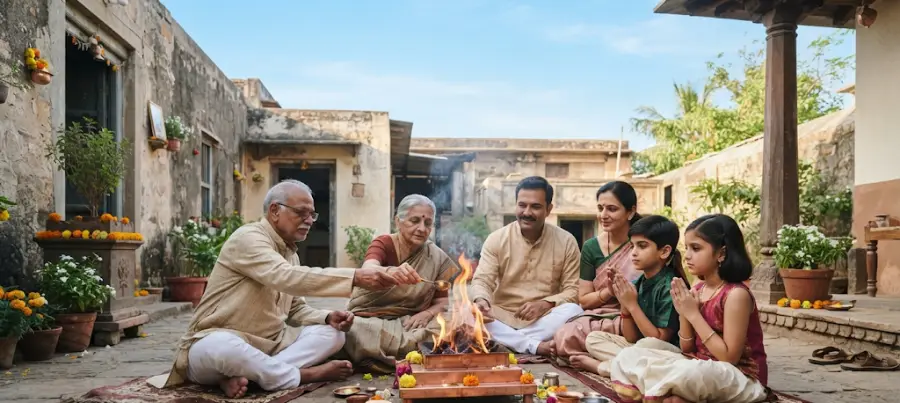
The sight of a small flame, the smell of ghee and the sound of a verse chanted together: for many families, a havan is the heart of a festival, a housewarming or a new beginning. It is one of the oldest rituals in the Indian tradition. Today, people in the UK, the US and Europe also search for havan and Agnihotra benefits, often asking if the practice cleans the air or improves health.
This guide explains what a havan is, how it appears in the Vedas, what it means to the people who perform it, and what health agencies say about smoke. We want you to enjoy the tradition and also stay safe.
The short version: Havan, or homa, is a Vedic fire ritual in which offerings such as ghee, grains and herbs are placed into a sacred fire while verses are chanted. Agnihotra is a simple daily form of it. Its meaning is spiritual and cultural. Claims that it purifies air or cures disease are not proven, and the World Health Organization warns that smoke indoors can harm health, so keep any fire well ventilated.
▶ Watch the Web Story: Havan and Agnihotra Benefits
Table of Contents
What Are Havan and Agnihotra?
A havan (also called homa or yajna) is a ritual in which offerings are made into a fire. The word Agnihotra means “the offering to Agni”, the fire. In tradition, it is a short daily ritual performed at sunrise and sunset.
Havans are done for many occasions: festivals, weddings, the opening of a new home, a birth or the memory of a loved one. The fire is seen as a carrier of prayers and a witness to a promise.
Fire in the Vedas
The Rigveda, the oldest Veda, opens with a hymn to Agni, the fire. This tells us how central fire was to the early Vedic world. If you want to know how the four Vedas are arranged, see our guide to the four Vedas.
Another famous verse, from the last hymn of the Rigveda, speaks of unity in a group that gathers around a shared ritual:
संगच्छध्वं संवदध्वं सं वो मनांसि जानताम्
saṃ gacchadhvaṃ saṃ vadadhvaṃ saṃ vo manāṃsi jānatām
Rigveda 10.191.2
Meaning: Move together, speak together, let your minds be of one accord.
The verse is about harmony. In a havan, people sit together, chant together and share a common purpose. That feeling of togetherness is one of the main reasons many people value the ritual.
Agnihotra Ritual in Simple Steps
The traditional form is performed by a trained person, with specific timings and verses. In broad outline, it includes:
- preparing a small, clean fire in a fireproof vessel
- sitting quietly and chanting the verses
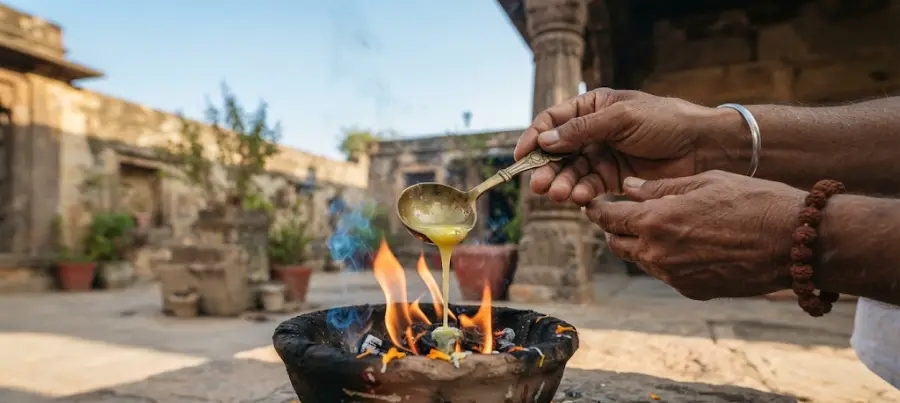
- offering small amounts of ghee and grains, saying “svaha” with each offering
- sitting in silence for a short time afterwards
- cleaning the place with care
We do not give detailed instructions for a full ritual here, because it should be learned from a qualified teacher. But the key idea is simple: a quiet, focused offering, done with respect.
What is offered and why
- Ghee: the traditional fuel and offering. Read more in our guide to ghee benefits.
- Grains and seeds: such as rice and sesame, as a symbol of food and abundance.
- Wood: dry sticks, traditionally of certain trees.
- Herbs: small amounts of dried plants in some traditions.
Each offering has symbolic meaning: giving food and light back to the world. This is part of the idea of yajna, which means giving, sharing and keeping the cycle of life going.
Havan Benefits: What Tradition Says
People who practise Agnihotra often speak of peace of mind, discipline, a sense of rhythm to the day and a feeling of connection to something larger. Tradition also attributes cleansing and healing powers to the fire.
These are spiritual and cultural experiences. They matter to many people, and we respect that. But it is honest to say that the claims about purifying air, curing diseases or protecting crops are not supported by strong scientific evidence.
Havan Smoke and Health: What Science Says
This is the part that every family should read. The World Health Organization explains in its fact sheet on household air pollution that smoke from burning fuels indoors, such as wood and other solid fuels, contains fine particles and other pollutants that can damage the lungs and heart. It links household air pollution to millions of premature deaths each year.
Those numbers come mainly from the daily use of open fires and basic stoves for cooking, not from a short ritual. But the same science applies: smoke is not good to breathe, and indoor air quality matters. A small, short havan is very different from cooking over smoky fuel all day, but it still makes smoke.
In plain words: there is no good proof that havan smoke purifies air, and there is good evidence that smoke can be harmful if it is breathed in, especially in a closed room.
How to Do a Havan Safely
- Do it outdoors, or in a very well-ventilated space.
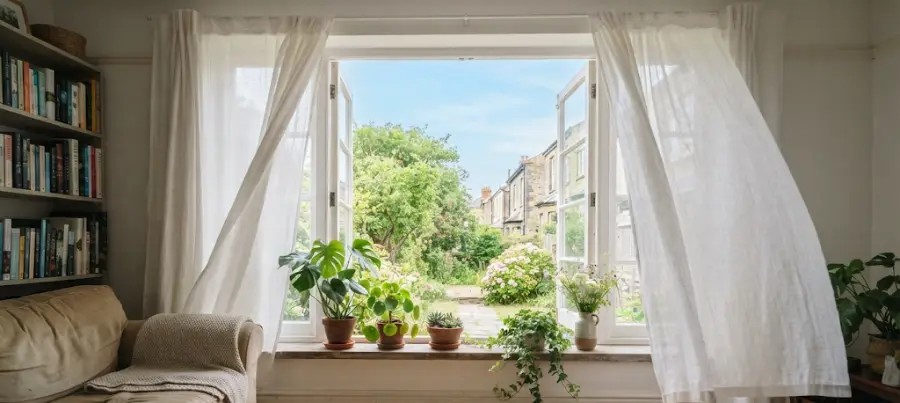
- Keep doors and windows open, and stay upwind.
- Use a small fire and only a little ghee and dry wood.
- Never leave the fire unattended.
- Use a fireproof vessel on a stable, non-flammable surface.
- Keep children, pets and flammable clothing away from the flame.
- Keep a bucket of water or sand nearby.
- Do not run a havan in a small, closed room.
- Put the fire out fully before leaving.
Havan at Home: A Safer Indoor Practice
Many modern families who live in flats, or in places with strict fire rules, choose a lamp-based ritual:
- Light a small ghee or oil lamp (diya) in a safe holder.
- Sit quietly and chant a verse or a few slow breaths.
- Keep a window open.
- Blow out the lamp carefully when done.
A lamp gives the same feeling of focus and ritual, with far less smoke. If you have asthma, allergies or heart or lung conditions, a lamp or simply a quiet chant may be the better choice.
Havan and community
Part of the beauty of a havan is that it gathers people. Neighbours, friends and relatives sit together, perhaps for the first time in weeks. A shared ritual can soften tensions and bring warmth.
You can create this feeling in other safe ways too: a shared meal, a group chant, a quiet walk. The point is the togetherness and the calm. See our guide to Vedic chanting and stress for ideas.
Symbolism and meaning
In the Vedic view, fire is a bridge between humans and the divine. Offering into fire is a way of saying thanks, of letting go and of starting again. For many people, the symbolism is the most precious part: giving something up, and receiving a quiet mind in return.
Who should avoid smoke
- People with asthma, COPD or other lung conditions.
- People with heart disease.
- Pregnant women.
- Babies and young children.
- Older adults with breathing difficulty.
- Anyone who feels short of breath, coughs or has itchy eyes near the smoke.
If you or someone in your family has any of these conditions, it is wise to choose a smoke-free alternative, or to stay far from the fire, and to speak to your doctor.
Common myths
- Myth: havan smoke cleans the air. There is no solid proof of this, and smoke itself is a pollutant.
- Myth: more smoke means more benefit. More smoke means more risk.
- Myth: a havan cures disease. No ritual replaces medical care.
- Myth: it must be done indoors. Traditionally it was done in the open air.
Havan and Agnihotra benefits: what is fair to say
When people ask about havan and Agnihotra benefits, it helps to sort the answers into three boxes: what is cultural, what is personal and what is scientific.
- Cultural: the ritual preserves an ancient tradition, marks important moments and brings the community together.
- Personal: many people feel calmer, more focused and more grateful after a quiet ritual, as with other meaningful routines.
- Scientific: there is no strong evidence that the smoke cleans air or treats disease, and there is good evidence that smoke can harm the lungs.
Seen this way, the honest havan and Agnihotra benefits are cultural and personal, such as meaning, rhythm and togetherness. Those are real and valuable. We do not need to add health claims that cannot be proven.
The meaning of “svaha”
During a havan, each offering is accompanied by the word svaha. It is a Vedic exclamation that marks the giving of an offering, much like a “so be it” or a “to you”. The word is repeated many times in the ritual, giving it a steady rhythm.
The meaning behind it is the idea of letting go. When you place something in the fire and say svaha, you give it away without holding on. Many people find this a useful picture for daily life as well: when we are worried, we can imagine placing our worries into a flame, and then taking a slow breath.
You can try this without any fire at all, by writing a worry on paper and putting it away, or by taking a slow breath out as you say the word “let go” to yourself.
Time of day: sunrise and sunset
Agnihotra is traditionally done at sunrise and sunset. These are moments when the day changes, and many cultures treat them as special. A pause at dawn and at dusk is also good for the body clock: morning light helps wake you up, and a calm evening helps you wind down.
If you do not practise Agnihotra, you can still borrow the idea. Step outside for a minute in the morning, look at the sky and take three slow breaths. In the evening, switch off bright screens and light a small lamp. For more on early-morning habits, see our guide to Brahma muhurta, and for the sun in tradition, see Surya Namaskar.
Fire safety basics every family should know
Fire safety is not the opposite of tradition. Taking care is a way of respecting the people who sit beside you.
- Choose a stable, flat place far from curtains, furniture and dry plants.
- Keep a bucket of water, a damp cloth or a fire extinguisher within reach.
- Tie back long hair and avoid loose, hanging sleeves near a flame.
- Make sure someone is responsible for watching the fire at all times.
- Never use petrol, alcohol or any quick-burning liquid to start a fire.
- Know the phone number of the local emergency services.
If your building has smoke alarms, check their rules before you light any fire indoors. Many apartment buildings do not allow it.
Making a havan eco-friendlier
A little thought can reduce the effect of your ritual on the air and the environment.
- Use dry, untreated wood, and not painted or treated timber, which can release harmful fumes.
- Use small quantities of ghee and grains.
- Avoid plastic, synthetic items or heavily scented products in the fire.
- Clear away ash and leftovers with care.
- Hold the ritual outdoors in a garden, park or courtyard where allowed.
These steps respect both the tradition and your neighbours, and they follow the spirit of yajna, which means giving back to the world rather than harming it.
Learning the tradition from a teacher
A full havan has many details: the type of vessel, the sequence of verses, the timing and the offerings. These details are best learned from a trained teacher or priest, who can answer your questions and correct small mistakes.
If you would like to learn, ask at a local temple or cultural centre, or look for a reputable teacher with good reviews and clear safety practices. Be careful with anyone who charges very high fees or promises dramatic results such as curing illness or bringing wealth. A good teacher is humble about what a ritual can and cannot do.
Havan at home: a short checklist before you begin
Before any home ritual that involves fire, run through this short checklist.
- Is the space open and well ventilated?
- Is anyone at risk from smoke, such as a baby, an older person or someone with asthma?
- Is the fire vessel stable and fireproof?
- Do I have water or sand nearby?
- Is someone watching the fire at all times?
- Is it allowed by my building or local rules?
If the answer to any of these is no, switch to a safer option, such as a lamp and a quiet chant. The meaning of the ritual does not depend on the size of the flame.
A closing thought on tradition and care
The havan is one of the longest-lived human rituals, and it is easy to see why. It brings people together, marks life’s turning points and gives a quiet pause in a noisy world. Those are real gifts.
The best way to honour a tradition is to understand it well. That means knowing its meaning, practising it safely, and speaking honestly about what it can and cannot do. If you enjoy the havan for its meaning and fellowship, and keep the smoke small and the air fresh, you can enjoy havan and Agnihotra benefits in the way that matters most: as a source of peace, gratitude and togetherness.
For related reading, explore our guides to the four Vedas, the Gayatri mantra and the Shanti mantra.
Havan and Agnihotra FAQs
Is havan good for health?
It can be good for the mind, as a calm and meaningful ritual. The smoke is not good for lungs, so keep it small and well ventilated.
What is the difference between havan and Agnihotra?
Havan is a general word for a fire ritual. Agnihotra is a simple, daily form of it offered at sunrise and sunset.
Is it safe to do havan at home?
It can be, if you keep the fire small, stay outdoors or in a very airy place, and follow fire safety rules.
Does havan purify the air?
There is no good scientific evidence for this. Smoke adds particles to the air.
What can I do instead of a havan?
Light a diya in a safe holder, chant quietly and keep a window open.
Further reading
This article is for general education and cultural information, not medical advice. If symptoms persist or worry you, please speak with a qualified healthcare professional. Images on this page were created with AI.