

If there is one Vedic verse that almost everyone has heard, it is the Gayatri Mantra. It is chanted at sunrise in homes, schools and temples, and it is also a favourite for quiet meditation. But how many of us know the Gayatri mantra meaning line by line?
In this guide, we go slowly. You will see the original Sanskrit, an easy transliteration, the meaning of each word, and a gentle way to practise it. We will also look at what modern research does and does not say about repeating a mantra, so you get honest information along with the inspiration.
The short version: The Gayatri Mantra (Rigveda 3.62.10) is a prayer to the divine light of the sun, asking for clear understanding. Its simple meaning is: “We meditate on the radiant glory of the divine; may it guide our thoughts.” Chanting it is a calm focus practice. Research on meditation shows modest benefits for stress and mood, but a mantra is not a medical treatment.
▶ Watch the Web Story: Gayatri Mantra Meaning
Table of Contents
Gayatri Mantra Origin: Where It Comes From
The Gayatri Mantra appears in the Rigveda, in book 3, hymn 62, verse 10. Tradition credits the sage Vishwamitra with this hymn. The verse is addressed to Savitr, the sun in its life-giving, inspiring form.
The name “Gayatri” comes from the metre in which the verse is composed. A Gayatri metre has three lines of eight syllables each, 24 syllables in total. The mantra is so well loved that the metre itself became a symbol, and in later tradition Gayatri is also honoured as a goddess.
If you are new to the texts, our guide to the four Vedas shows where the Rigveda fits in the bigger picture.
Gayatri Mantra in Sanskrit and English
Here is the mantra as it is commonly chanted, with the three opening sounds that tradition adds from the Yajurveda:
ॐ भूर्भुवः स्वः । तत्सवितुर्वरेण्यं भर्गो देवस्य धीमहि । धियो यो नः प्रचोदयात् ॥
Om bhūr bhuvaḥ svaḥ | tat savitur vareṇyaṃ bhargo devasya dhīmahi | dhiyo yo naḥ pracodayāt ||
Rigveda 3.62.10 (with the opening invocation)
Meaning: We meditate on the excellent radiance of the divine Savitr; may he inspire our thoughts.
Do not worry if the Sanskrit feels hard at first, because the Gayatri mantra meaning is easy to learn once you know a few words. Read it slowly, one line at a time. Listening to a good recording helps a lot with the sounds.
Gayatri Mantra meaning, word by word
Let us break it down into small pieces. This is the easiest way to feel the Gayatri mantra meaning for yourself:
- Om: the sacred syllable, a sound of the whole.
- Bhūr: the earth, the physical world.
- Bhuvaḥ: the space in between, the world of life and breath.
- Svaḥ: the sky or the heavens, the world of light and mind.
- Tat: “that”, pointing to the highest reality.
- Savitur: of Savitr, the sun as the source of light and inspiration.
- Vareṇyam: worthy of choosing, excellent.
- Bhargo: radiance, brilliance.
- Devasya: of the divine.
- Dhīmahi: “we meditate upon” or “we hold in mind”.
- Dhiyo: our thoughts, understanding, intellect.
- Yo naḥ: who (may he) … our.
- Pracodayāt: may he inspire, may he guide, may he awaken.
Translators choose slightly different English words, such as “glory”, “splendour” or “radiance” for bhargo. That is normal. Sanskrit words often carry several shades of meaning.
The meaning in one simple sentence
If you want one sentence to remember, use this:
“We meditate on the divine light that gives life to the world; may it guide our thinking toward what is right and clear.”
Notice something important. The mantra does not ask for money, success or health. It asks for clear thinking. That is why many students, teachers and professionals like to start the day with it.

Why the sun (Savitr) is called on
In the Vedic world, the sun is not just a ball of fire. It is the source of light, warmth, food and the rhythm of days. Savitr is the aspect of the sun that “sets in motion” or “stirs to life”, the one that wakes the world each morning.
So when we chant to Savitr, we are also honouring the daily cycle that every living thing depends on. Many readers also like to connect this with the habits of rising with daylight. You may enjoy our guides on Brahma Muhurta and Surya Namaskar, which come from the same respect for the morning sun.
The three sacred sounds: Bhur, Bhuvah, Svah
The opening words bhūr bhuvaḥ svaḥ are called the mahavyahritis, the “great utterances”. They name three levels of existence:
- Bhūḥ is the earth, our body and the ground under our feet.
- Bhuvaḥ is the middle space, our breath and energy.
- Svaḥ is the bright space of the mind and spirit.
One lovely way to chant is to feel these three levels as you speak: the feet and body, then the chest and breath, then the head and thoughts. You do not have to believe anything special. It is simply a method of paying attention.
How to Chant the Gayatri Mantra
Traditionally, the Gayatri Mantra is chanted three times a day, at the junctions of the day called sandhya: sunrise, midday and sunset. Many modern practitioners choose only the morning, which is practical and enough.
Some traditions count repetitions with a mala (a string of 108 beads). The number 108 is considered sacred, but it is not a rule. Even three or eleven repetitions said with full attention are fine.
Practices differ between families and traditions. Some lineages teach specific rules about initiation and who may chant. Many modern teachers welcome everyone. If this matters to you, ask a teacher you trust, and respect your own family tradition.
Gayatri Mantra Chanting: A Simple 10-Minute Practice
This is a gentle routine for beginners. You can do it at home, with no special equipment:
- Find a calm spot. Sit on a cushion or a chair, spine tall but relaxed, ideally facing the morning light.
- Settle your breath. Take three slow breaths. Let your shoulders drop.
- Say the meaning first. Read the simple sentence above once, slowly.
- Chant softly. Say the mantra in a low, steady voice, three or eleven times. Do not strain.
- Rest in silence. Sit quietly for two or three minutes. Notice your breath and your mind.
- Close with thanks. Fold your hands, and end with a quiet “thank you”.
Keep it easy. Understanding the Gayatri mantra meaning makes chanting feel natural. A calm five minutes you can repeat every day is better than a long session you give up after a week.
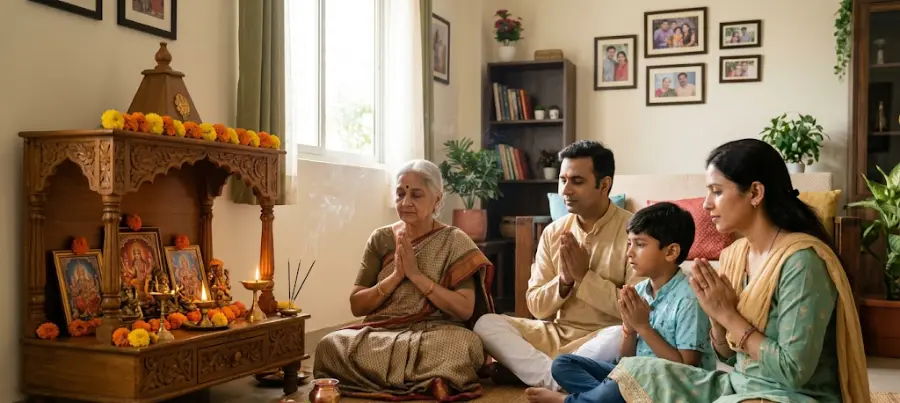
Gayatri Mantra Benefits: What Research Says About Mantra Repetition
Here we should be honest, and stay with what is known. The US National Center for Complementary and Integrative Health (NCCIH) describes focused meditation as holding attention on a sensation, a sound, an image or a mantra, which is a word or phrase repeated again and again. So chanting a mantra fits into a well-studied family of practices.
For meditation in general, NCCIH reports that a large 2018 analysis of 142 groups found mindfulness better than no treatment for anxiety and depression and about as effective as some established therapies. For anxiety disorders specifically, results were more mixed in the short term, with few studies following people beyond two months. The evidence for sleep is similar: mindfulness improved sleep quality compared with education-based treatments, but not more than cognitive behavioural therapy or exercise.
What does this mean for the Gayatri Mantra? Three things:
- It is reasonable to expect that calm, focused repetition may help some people relax.
- Studies of one specific mantra are small, so we cannot say the Gayatri Mantra is better than any other focus.
- Meditation is usually low-risk, but it is not a treatment for illness. NCCIH advises against using it to replace conventional care or to delay seeing a health provider.
Safety and common-sense notes
Chanting is gentle, but a few cautions are wise:
- Do not force your voice. If your throat feels tight, chant softly or silently.
- Sit comfortably. Use a chair if the floor hurts your knees or back.
- Stop if you feel uneasy. NCCIH notes that about 8% of participants in a large review of meditation studies reported a negative effect, most often anxiety or low mood. If silence or repetition makes you feel worse, stop and talk to a health professional.
- Keep your medical care. A mantra can sit beside treatment, not replace it.
- Be careful with claims. Be cautious of anyone who says the mantra cures disease or guarantees success.
Mistakes beginners make
- Chasing perfect pronunciation. Good sounds matter, but kindness to yourself matters more. Improve a little each week.
- Chanting too fast. Slowing down helps the mind settle.
- Treating it as a task. It is a pause, not a chore.
- Expecting quick results. Give it a few weeks before you judge it.
- Comparing with others. Your practice is yours.
How to make it part of a busy day
Few of us can sit for an hour. Here are small ways to keep the habit alive:
- Chant once while the kettle boils.
- Say it silently during your commute, while you walk or when you wait.
- Pair it with a habit you already have, such as brushing your teeth or opening the curtains.
- Listen to a short recording if you are too tired to chant.
- On hard days, simply remember the meaning: “may my thinking be clear”.
If you would like to deepen your practice, read about Om chanting, or learn another famous verse in our Mahamrityunjaya Mantra guide.
Gayatri Mantra Meaning in Hindi
बहुत से पाठक सरल हिंदी में भी अर्थ जानना चाहते हैं। इसलिए यहाँ आसान शब्दों में Gayatri mantra meaning दिया गया है:
तत्सवितुर्वरेण्यं भर्गो देवस्य धीमहि । धियो यो नः प्रचोदयात् ॥
tat savitur vareṇyaṃ bhargo devasya dhīmahi | dhiyo yo naḥ pracodayāt ||
ऋग्वेद 3.62.10
Meaning: हम उस देव सविता के श्रेष्ठ तेज का ध्यान करते हैं, जो हमारी बुद्धि को सही दिशा में प्रेरित करे।
यानी यह मंत्र किसी चीज़ की माँग नहीं करता। यह केवल इतना माँगता है कि हमारी सोच साफ़ हो और हमारी बुद्धि सही रास्ता चुने।
How children can learn the mantra
Children often learn the Gayatri Mantra at home or school. The best way is gentle and playful, never forced. Here are some easy ideas:
- Chant together for one minute after breakfast. Short and happy is best.
- Teach one line a day. Four days later, they know the whole verse.
- Explain the meaning in a sentence they can hold: “Please help me think clearly.”
- Let them listen to a calm recording before school or at bedtime.
- Praise effort, not perfection.
How it compares with other well-known mantras
Many readers ask how this verse differs from other Vedic favourites. Here is a short, simple comparison:
- Gayatri Mantra: asks for clear understanding (Rigveda 3.62.10).
- Mahamrityunjaya Mantra: asks for strength and freedom from fear of death (Rigveda 7.59.12). Read our Mahamrityunjaya guide.
- Om: a single sacred sound, used on its own or to begin other mantras. See Om chanting.
- Shanti mantras: short prayers for peace in the self, the world and nature. See Shanti mantras.
Each one has a different mood. You can pick the one that fits your day, or use the Gayatri Mantra as your daily anchor and the others for special moments.
Respect, tone and attitude
A mantra is a gift of a living tradition, so it is nice to approach it with respect. That does not mean being stiff or fearful. It simply means being sincere:
- Wash your face and hands, or just pause and take a breath, before you begin.
- Try to say the words correctly, and be happy to be corrected.
- Be humble about what you do not know. Ask a teacher.
- Never use it to boast, to frighten others, or to sell something.
- Be kind to people who follow different traditions.
This respectful, curious attitude is what makes any Gayatri mantra meaning feel alive, instead of a block of foreign words.
A short Gayatri practice for beginners
If you would like to try the Gayatri mantra, keep your first practice short and calm. You do not need any special items.
- Sit comfortably and take three slow breaths.
- Read the meaning once, so the words are not only sound.
- Listen to a recording from a respected teacher.
- Chant slowly three or nine times, or listen and repeat quietly.
- Sit in silence for a minute and notice how you feel.
Many people prefer to chant at sunrise, when the air is quiet. But any calm moment works. If you feel dizzy, stop and breathe normally. As with every practice on this site, a mantra is a spiritual and calming habit, not a medical treatment.
Learning more after the Gayatri mantra
Once you are comfortable with the Gayatri mantra, you may want to explore related verses and ideas. Our guide to the four Vedas shows where the mantra sits in the Rigveda. Our guides to Om chanting and the Shanti mantra introduce two other well-loved sounds of the tradition.
You can also read about the early-morning habits that many people link with mantra practice in our guide to Brahma muhurta. Take your time, and enjoy the learning. There is no hurry in a tradition that has lasted for thousands of years.
Gayatri Mantra Meaning FAQs
What is the Gayatri Mantra meaning in English?
A simple version is: “We meditate on the radiant glory of the divine Savitr; may he inspire and guide our thoughts.”
How many times should I chant the Gayatri Mantra?
Traditionally 108 times with a mala, but three or eleven times is enough for beginners. Quality of attention matters more than the count.
Which Veda is the Gayatri Mantra from?
It is from the Rigveda, book 3, hymn 62, verse 10. The opening words “Om bhūr bhuvaḥ svaḥ” are added from the Yajurveda tradition.
Can anyone chant the Gayatri Mantra?
Traditions differ. Some have specific rules, while many modern teachers say it is open to all sincere seekers. Follow your family tradition and learn from a teacher you respect.
Is it better to chant out loud or silently?
Both are used. Chanting aloud helps with rhythm and focus, and silent repetition is often used in meditation. Choose what feels natural.
Does the Gayatri Mantra have scientific benefits?
Research on meditation suggests modest benefits for stress and mood, but there is little high-quality research on this specific mantra. Enjoy it for its meaning and calm, not as a cure.
Further reading
- NCCIH: Meditation and Mindfulness: What You Need To Know
- NCCIH: Relaxation Techniques: What You Need To Know
This article is for general education and cultural information, not medical advice. If symptoms persist or worry you, please speak with a qualified healthcare professional. Images on this page were created with AI.